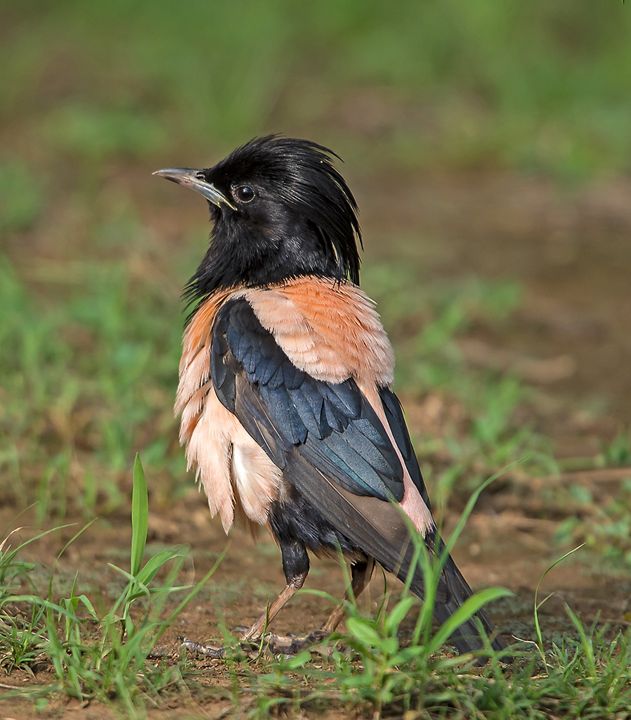
The size of a common starling, 19–22 cm and 60–88 g. The breeding plumage is unmistakable: pink body, glossy black head, wings and tail, pink to pale orange legs, a bill with a black base and bright pink tip. Breeding males have elongated head feathers forming a wispy crest raised when excited. In winter the body is dull greyish pink, the bill grey and the crest shorter. Females have a shorter crest and a less sharp pink-black boundary; juveniles are pale buffy brown.
Habitat
Open farmland, steppe and semi-desert, in large flocks following locusts; nests colonially in rock piles, holes and on the ground. In winter in flocks on fields and in villages, often with other starlings.
Distribution
Breeds from eastern Europe to western Central Asia, with Xinjiang in China an important breeding area where stone piles are built to attract them against locusts; winters in India and Sri Lanka. Only vagrants or a few wintering birds in eastern China, Japan and Singapore, with occasional records around Shanghai.
Season and behaviour
Breeds in Xinjiang from May to July, the flocks moving with the locusts; occasional in eastern China from October to March. At dusk thousands wheel together before dropping into reeds or trees to roost.
Photography tips
These are the FilmAnalysis editors' notes, not content from the sources.
The locust-hunting flocks on the Xinjiang steppe are a spectacle: a slightly wider lens for the shape of the flock at 1/2000 s; a single bird's pink and black wants front light. Vagrants hide in flocks of white-cheeked starlings, so find the differently coloured one first, then a long lens for bill and crest.
Field ethics: keep a distance at which the bird does not change its behaviour; never approach or publish nest sites; no baiting, playback or flash; never clear vegetation around a nest; follow reserve rules and stay on paths.
Photographic styles
Pink flocks over the steppe; pink against black.
Similar species
Common starling (all glossy black with white spots, no pink); juveniles resemble young common starlings but are paler with a shorter, thicker bill.
Related badge
None yet. No validated photo recognition exists for this species, so no badge is tied to it: a name in the encyclopedia is not evidence in a photograph.
The illustration is original FilmAnalysis artwork. The photograph is from Wikimedia Commons; its licence and author are under it.