PAL, AF (s Europe to c Asia, nw Africa and Ethiopia)
IOC non-breeding range
n AF, OR
Identification
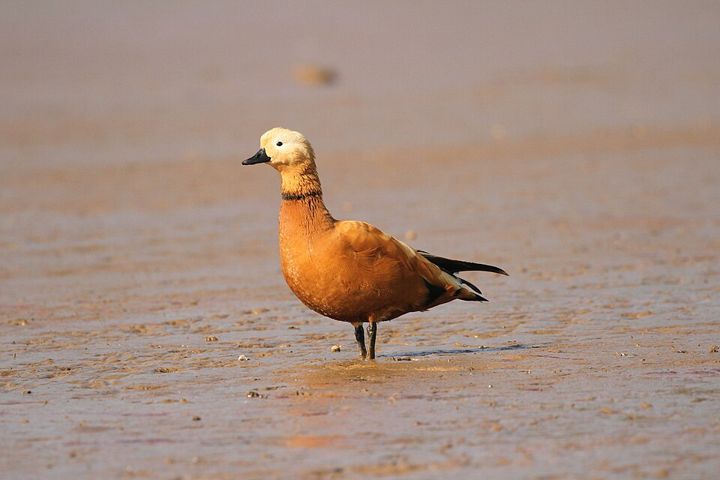
A distinctive large duck, 58–70 cm long with a 110–135 cm wingspan. The male has orange-brown body plumage with a paler orange-buff head and neck and a narrow black collar; rump, flight feathers and tail are black, with a green speculum on the inner wing; both wing-covert surfaces are white, very noticeable in flight and hardly visible at rest. Black bill, dark grey legs. The female is similar with a whitish head and neck and no collar. The colours fade as the feathers age.
Habitat
Lakes, rivers, reservoirs and open farmland, usually in pairs or small groups grazing on banks, and breeding at high-altitude and saline lakes; nests in burrows, cliff crevices and tree holes.
Distribution
Breeds from south-eastern Europe to Central Asia with small resident populations in north-west Africa and Ethiopia; winters on the Indian subcontinent, in North Africa and northern South-East Asia. Breeds in northern China and on the Tibetan plateau and winters in the Yangtze basin and southern China, where it is very common; a scarce winter visitor to Japan; absent from Singapore.
Season and behaviour
Winters in flocks in eastern China from October to March, breeding in the north and on the plateau from April to August. A loud aakh, exchanged as pairs fly over. Regarded as auspicious in Tibetan Buddhist regions and very tame there.
Photography tips
These are the FilmAnalysis editors' notes, not content from the sources.
The orange-brown saturates in low warm light, so shoot early or late; in flight the white coverts against black flight feathers is the moment, at 1/2000 s. They move in pairs: put both in the frame. Birds by plateau lakes allow close approach, so a medium lens can include snow mountains and water.
Field ethics: keep a distance at which the bird does not change its behaviour; never approach or publish nest sites; no baiting, playback or flash; never clear vegetation around a nest; follow reserve rules and stay on paths.
Photographic styles
Warm orange beside a plateau lake; compositions in pairs.
Similar species
Common shelduck (mostly white, green head, chestnut breast band); female gadwall and wigeon are brown but far smaller, without white coverts.
Related badge
The album badge "a duck" unlocks when the vision model explicitly names a a duck in your photo and you rate the analysis. The badge stops at "a duck": it does not tell species apart, and this page existing unlocks nothing.
The illustration is original FilmAnalysis artwork. The photograph is from Wikimedia Commons; its licence and author are under it.