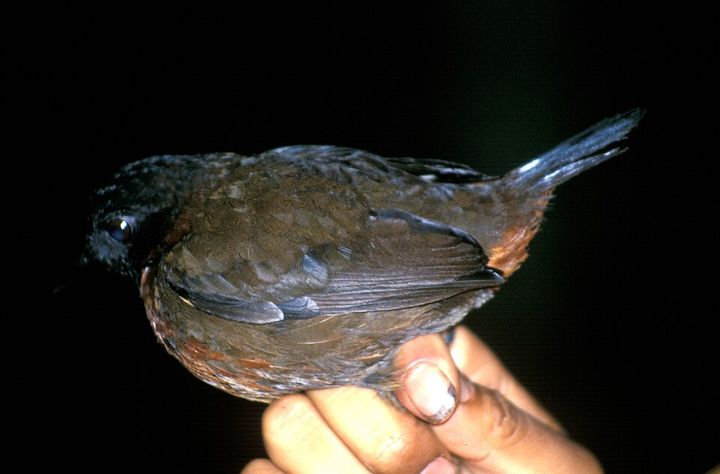
Photo: José Loaiza, Aves y Conservación, via Wikimedia Commons, public domain / CC0. Unmodified apart from resizing.
Region
Elsewhere (in East Asia only in bird parks or botanic gardens)
Habitat
forest
Colour
brown, orange, black
Size
small (under about 20 cm)
IUCN status
Least Concern
IOC breeding range
MA, SA (Costa Rica to nw Venezuela and se Peru)
Identification
18–19 cm long, males 70–78 g and females 65–82 g, the sexes alike. The nominate race has a dark chestnut crown, nape and neck sides, blackish face and throat with a bluish-white ring of bare skin round the eye; dark brown back and wings, dark rufescent-brown rump and uppertail coverts, blackish tail, a wide cinnamon band at the base of the flight feathers; rufous-chestnut breast, pale rufous belly, olive-brown flanks. Brown or reddish-brown iris, black bill. It walks the forest floor like a small hen with the tail cocked.
Habitat
The floor of humid montane forest, turning leaf litter for ants and other insects, secretive and found mostly by voice.
Distribution
The mountains of Costa Rica, Panama, Colombia, north-west Venezuela, Ecuador and south-east Peru. Absent from East Asia; Birdwatching Notebook lists it as an exotic.
Season and behaviour
Resident, seen all year within its range; calls at dawn and dusk.
Photography tips
These are the FilmAnalysis editors' notes, not content from the sources.
Forest-floor light is very weak: high ISO, a wide aperture, 1/250 s, and wait for it to walk into a patch of light. The blue-white eye-ring is the focus point. Locate it by voice but do not use playback to draw it out.
Field ethics: keep a distance at which the bird does not change its behaviour; never approach or publish nest sites; no baiting, playback or flash; never clear vegetation around a nest; follow reserve rules and stay on paths.
Photographic styles
A small bird among forest-floor leaves; chestnut and black in low light.
Similar species
Other Formicarius antthrushes such as the black-faced (different breast colours).
Related badge
None yet. No validated photo recognition exists for this species, so no badge is tied to it: a name in the encyclopedia is not evidence in a photograph.
The illustration is original FilmAnalysis artwork. The photograph is from Wikimedia Commons; its licence and author are under it.