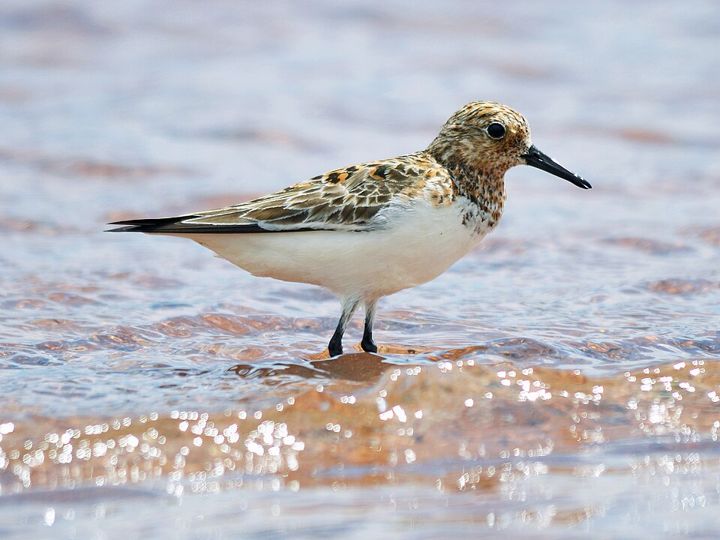
Photo: Jacob Spinks from Northamptonshire, England, via Wikimedia Commons, licensed CC BY 2.0. Unmodified apart from resizing.
Region
Japan and temperate East Asia, Singapore and tropical Asia
Habitat
coast and mangroves
Colour
white, grey, red
Size
small (under about 20 cm)
IUCN status
Least Concern
IOC breeding range
NA, PAL (high Arctic tundra wetlands of Holarctic: nw, se Greenland, Svalbard (n of Norway), n Taymyr Pen. and Severnaya Zemlya (to n), Lena Delta and New Siberian Is. (nc Siberia), Alaskan North Slope (rare), Canadian Arctic islands from Banks to Ellesmere and s to Southampton)
IOC non-breeding range
Worldwide : sandy coastal beaches from temperate to tropical zone: British Isles and Macaronesia (nw of n Africa) through Africa, Malagasy region, Middle East, s, se Asia through Indonesian Arch. to Australia, Melanesia, Philippines and s, c Japan (but rare New Guinea and New Zealand); sw, se Canada and Caribbean s to Tierra del Fuego and including remote islands through e Polynesia
Identification
A small plump sandpiper, 18–20 cm long and 40–100 g. The winter bird is very pale, almost white apart from a dark shoulder patch; by late summer the face and throat turn brick red. Juveniles are spangled black and white with more contrast than adults. It has no hind toe, alone in its genus. Running back and forth at the edge of the waves like a clockwork toy is its most distinctive habit.
Habitat
Breeds on the coldest High Arctic tundra; outside the breeding season almost only on sandy beaches, chasing the waves in and out for small invertebrates, sometimes on mudflats.
Distribution
Circumpolar breeder in the High Arctic of North America, Europe and Asia and a long-distance migrant wintering in South America, western and southern Europe, Africa, the coasts of Asia and Australia. On the beaches of eastern China and Japan from September to May; occasional in Singapore.
Season and behaviour
Passage peaks in China and Japan in April–May and August–October, with some wintering. Highly gregarious in winter, in tight flocks running with the surf.
Photography tips
These are the FilmAnalysis editors' notes, not content from the sources.
Lie on the sand and let them run towards you: from low down the surf, the reflections and the short legs all fit the frame, at 1/2000 s or faster for the running feet. The near-white winter plumage needs a little extra exposure when metering off wet sand. A front-lit evening beach is the softest background.
Field ethics: keep a distance at which the bird does not change its behaviour; never approach or publish nest sites; no baiting, playback or flash; never clear vegetation around a nest; follow reserve rules and stay on paths.
Photographic styles
Small white dots on a beach; surf and running.
Similar species
Dunlin (long drooping bill, grey-brown winter plumage); red-necked stint (smaller, has a hind toe, grey-brown back); among small winter sandpipers this is the whitest.
Related badge
None yet. No validated photo recognition exists for this species, so no badge is tied to it: a name in the encyclopedia is not evidence in a photograph.
The illustration is original FilmAnalysis artwork. The photograph is from Wikimedia Commons; its licence and author are under it.