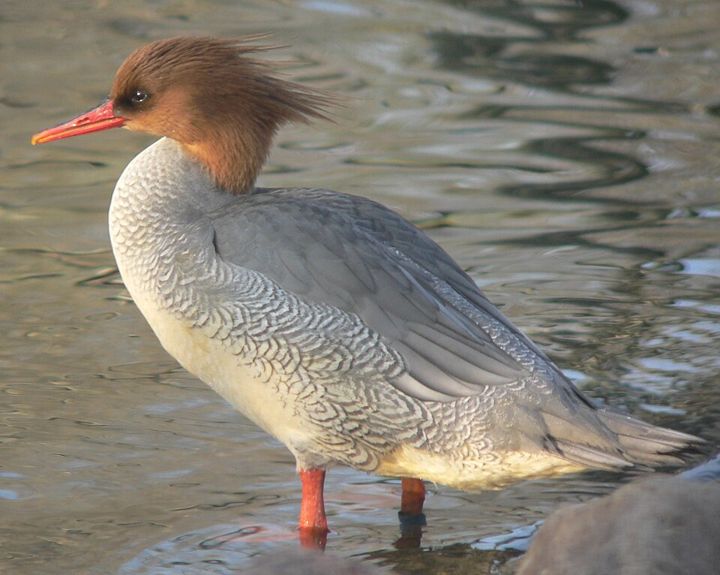
A striking merganser with a thin red bill and a scaled dark pattern on the flanks and rump that gives its name. Both sexes have a crest of wispy elongated feathers, reaching almost to the shoulders in adult males and shorter in females and immatures. The male has a black head and neck, white breast and underparts and blackish mantle and wings with white inner wings; the female has a buffish head and grey where the male is black. Legs orange-red, iris dark brown.
Habitat
Breeds on clear fast rivers in primary forest, nesting in holes in old riverside trees; winters on clean rivers and reservoirs, diving for fish, and is highly sensitive to water quality.
Distribution
Breeds in the south-eastern Russian Far East, perhaps North Korea, and at a few sites in China's Changbai and Lesser Khingan mountains, the bulk of the population in Russia; winters on rivers in south-central China (Jiangxi, Hunan, Hubei, Guangdong and elsewhere), in Korea and in small numbers in Japan. A first-class protected species in China since 1989, nicknamed the national duck. A few thousand remain; endangered.
Season and behaviour
On clear rivers in south-central China from November to March, in small groups diving in the riffles; breeds on forest rivers in the north-east from April to July. In Japan a few winter on rivers of Kyushu and western Honshu.
Photography tips
These are the FilmAnalysis editors' notes, not content from the sources.
Its flight distance is long: a car, a hide and 600 mm or more from the bank; at dawn against the light the red bill and crest make the outline. The scaled flanks need side light and closeness. Never follow them along the river, since once flushed they fly far downstream and winter energy is precious. Seeing one is luck enough; do not trade the quiet of its river for a closer frame.
Field ethics: keep a distance at which the bird does not change its behaviour; never approach or publish nest sites; no baiting, playback or flash; never clear vegetation around a nest; follow reserve rules and stay on paths.
Photographic styles
Black, white and red on a clear rapid; quiet winter river scenes.
Similar species
Common merganser (male with plain white flanks and a short crest; female with a chestnut head); red-breasted merganser (male with a streaked chestnut breast and finely marked grey flanks, mostly at sea).
Related badge
The album badge "a duck" unlocks when the vision model explicitly names a a duck in your photo and you rate the analysis. The badge stops at "a duck": it does not tell species apart, and this page existing unlocks nothing.
The illustration is original FilmAnalysis artwork. The photograph is from Wikimedia Commons; its licence and author are under it.