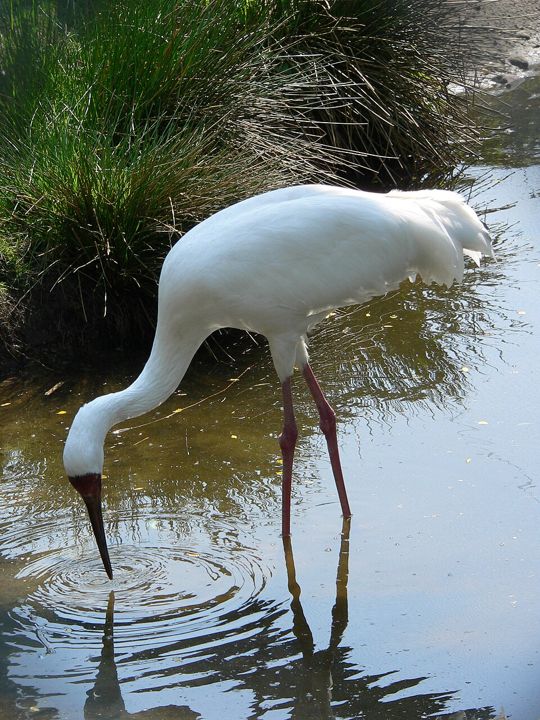
A fairly large crane standing about 140 cm, weighing 4.9–8.6 kg with a wingspan of 210–260 cm. Adults are pure white except for black primaries, alula and primary coverts, visible in flight; the forecrown, face and head sides are bare brick-red, the bill dark, the legs pinkish, the iris yellowish. Juveniles have feathered faces and dingy brown plumage. There are no elongated tertials as in other cranes. The call is not a trumpet but a goose-like high whistle.
Habitat
Breeds on Arctic tundra wetlands; winters on shallow lakes and marshes, digging the tubers of water plants in the shallows, the most wetland-dependent of all cranes.
Distribution
Two breeding populations: the eastern breeds in north-east Siberia and winters in China, almost entirely at Poyang Lake; the western breeds in western Siberia and winters in Iran (formerly also at Bharatpur, India) and is down to a handful of birds. About four thousand remain worldwide; critically endangered. An occasional vagrant to Japan; absent from Singapore.
Season and behaviour
At Poyang Lake from November to March, where nearly all the world's Siberian cranes winter, often with white-naped and common cranes and many geese and ducks; departs north in late March.
Photography tips
These are the FilmAnalysis editors' notes, not content from the sources.
The grasslands and shallows of Poyang are the only stage: a car or hide, 600 mm upwards, and room in the frame, since a great white bird on tawny winter grass is the picture by itself. Groups in early mist and the take-off that reveals the black wingtips are the best moments, at 1/1600 s; half a stop under for white plumage. A critically endangered species: keep hundreds of metres from the flock.
Field ethics: keep a distance at which the bird does not change its behaviour; never approach or publish nest sites; no baiting, playback or flash; never clear vegetation around a nest; follow reserve rules and stay on paths.
Photographic styles
Great white birds in lake mist; the instant of black wingtips.
Similar species
White-naped crane (red crown, grey-and-white striped neck, grey body); red-crowned crane (black neck and tertials, red crown); Oriental stork (thick straight bill, red legs, black secondaries too).
Related badge
The album badge "a crane" unlocks when the vision model explicitly names a a crane in your photo and you rate the analysis. The badge stops at "a crane": it does not tell species apart, and this page existing unlocks nothing.
The illustration is original FilmAnalysis artwork. The photograph is from Wikimedia Commons; its licence and author are under it.