Singapore and tropical Asia, Japan and temperate East Asia
Habitat
coast and mangroves
Colour
brown, orange, white
Size
small (under about 20 cm)
IOC breeding range
PAL (e Russia (s, se Siberia))
IOC non-breeding range
coastal Kyushu and Ryukyu Is. (=Nansei Shoto; s Japan), coastal Taiwan and Vietnam to Australia, New Guinea region, Melanesia and w Micronesia
Identification
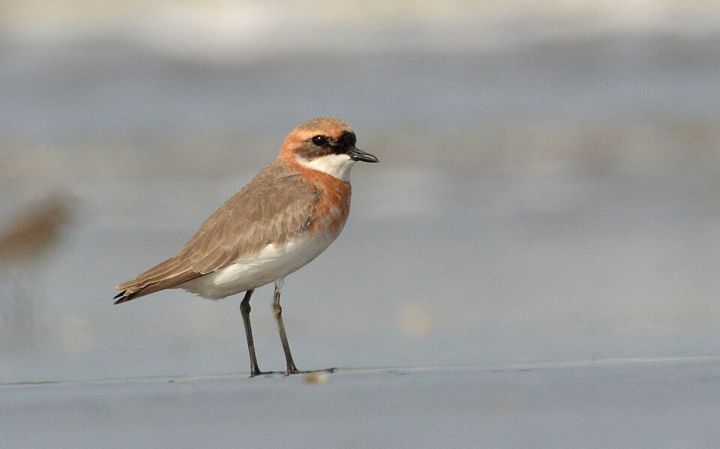
A chunky plover, long-legged and long-billed. Breeding males have grey backs and white underparts with chestnut breast, forehead and nape and a black eye mask; females are duller, and winter and juvenile birds lack the chestnut apart from a hint of rufous on the head. Dark legs, black bill. In all plumages very like the greater sand plover, told in mixed flocks by size and structure and hard to name alone. After the IOU split off the Tibetan sand plover, this species was renamed from lesser sand plover.
Habitat
Breeds in the mountains and tundra of southern and south-eastern Siberia; outside the breeding season on coastal mud, sand and estuaries in flocks with other waders.
Distribution
Breeds in eastern Russia (southern and south-eastern Siberia); winters on the coasts of Kyushu and the Ryukyus in Japan, Taiwan and Vietnam south to Australia, New Guinea and Melanesia. The east China coast is an important staging area and it is common on Singapore's coast in winter.
Season and behaviour
On the east China coast in April–May and August–October, in chestnut breeding dress in spring; in Singapore from September to April; winters in southern Japan.
Photography tips
These are the FilmAnalysis editors' notes, not content from the sources.
The chestnut breast band of spring passage is the picture, front-lit from low down; a frame with a greater sand plover beside it, comparing bill and leg length, is the most useful identification shot. At high tide the flock comes to the shore: lie on the flats and wait, 1/1600 s.
Field ethics: keep a distance at which the bird does not change its behaviour; never approach or publish nest sites; no baiting, playback or flash; never clear vegetation around a nest; follow reserve rules and stay on paths.
Photographic styles
Chestnut-breasted small plovers on the flats; one warm note on grey mud.
Similar species
Greater sand plover (larger, longer heavier bill, longer yellowish-green legs); Tibetan sand plover (the newly split relative, black line above the breast band when breeding); Kentish plover (incomplete breast band).
Related badge
None yet. No validated photo recognition exists for this species, so no badge is tied to it: a name in the encyclopedia is not evidence in a photograph.
The illustration is original FilmAnalysis artwork. The photograph is from Wikimedia Commons; its licence and author are under it.