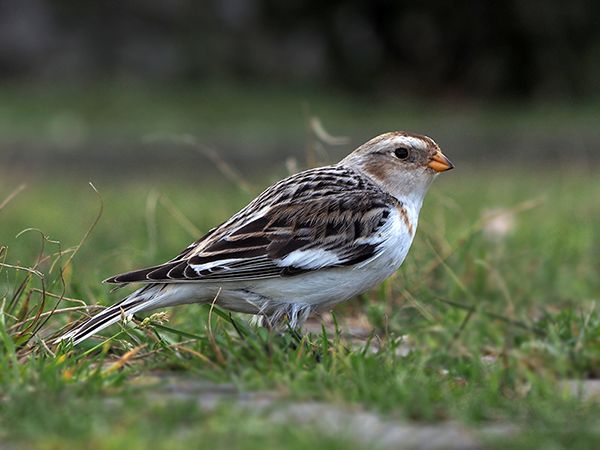
Photo: Amasuela - Luis Lafuente Agudín, via Wikimedia Commons, licensed CC BY-SA 4.0. Unmodified apart from resizing.
Region
Japan and temperate East Asia
Habitat
coast and mangroves, towns and gardens
Colour
white, black, brown
Size
small (under about 20 cm)
IUCN status
Least Concern
IOC breeding range
NA, PAL (n)
IOC non-breeding range
Mediterranean, s USA
Identification
A medium-sized, long-winged bunting, 15 cm long, wingspan 32–38 cm, 30–40 g. White below with black and white on the wings and back, the large white wing patches striking in flight. The breeding male is white with a black back and wingtips, the female has black wingtips and brown-fringed black back feathers; in winter both have broad orange-brown fringes on the back and a yellow bill with a black tip (all black in summer males). It walks and runs on the ground.
Habitat
An Arctic specialist, breeding on circumpolar tundra and a few high mountain tops; in winter in flocks on coasts, open low hills, roadside grass clear of snow and fields. The most northerly recorded passerine in the world.
Distribution
Circumpolar Arctic breeder with isolated populations on mountains such as Scotland's Cairngorms; winters south to the Mediterranean and the southern United States. In China in winter in Heilongjiang, Jilin, Inner Mongolia, Xinjiang and Hebei; common in winter on the coasts of Hokkaido and northern Honshu; absent from Singapore.
Season and behaviour
In north-east China and Hokkaido from November to March, feeding in flocks on bare roadside ground and beaches after snow; the Hokkaido coast is East Asia's most reliable site.
Photography tips
These are the FilmAnalysis editors' notes, not content from the sources.
A white bird on snow needs one to one and a half stops more, metering on the bird. When the flock rises the white wing patches swirl like snowflakes, at 1/2000 s with a slightly wider lens. Roadside feeders tolerate cars, so approach slowly; the brown-fringed winter plumage has depth in side light.
Field ethics: keep a distance at which the bird does not change its behaviour; never approach or publish nest sites; no baiting, playback or flash; never clear vegetation around a nest; follow reserve rules and stay on paths.
Photographic styles
White flocks on snow and beach; black, white and brown winter.
Similar species
Lapland longspur (mainly brown, no large white wing patches, often together); white wagtail (long wagging tail, not a bunting).
Related badge
None yet. No validated photo recognition exists for this species, so no badge is tied to it: a name in the encyclopedia is not evidence in a photograph.
The illustration is original FilmAnalysis artwork. The photograph is from Wikimedia Commons; its licence and author are under it.