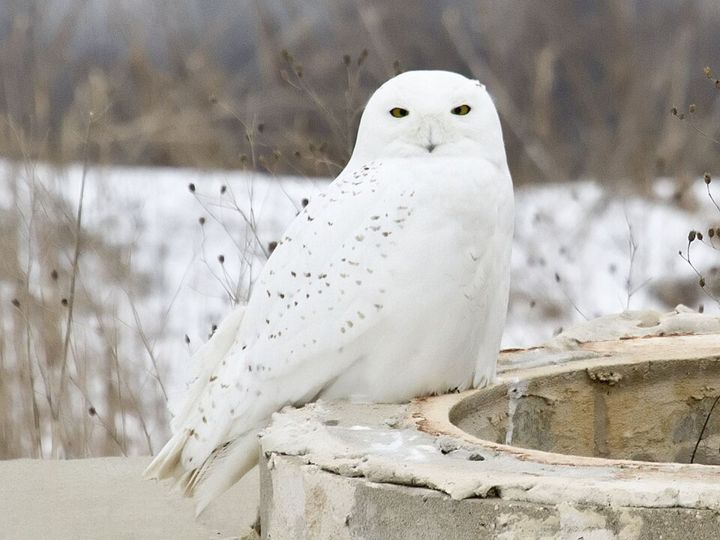
Photo: Bill Bouton from San Luis Obispo, CA, USA, via Wikimedia Commons, licensed CC BY-SA 2.0. Unmodified apart from resizing.
Region
Japan and temperate East Asia
Habitat
towns and gardens
Colour
white, black, yellow
Size
large (over 50 cm)
IUCN status
Vulnerable
IOC breeding range
NA, PAL (widespread in the n)
Identification
A large white owl, the only owl with mainly white plumage. Males are nearly pure white, females and young barred dark on white; whiter than polar bears or Arctic foxes, in the field it often looks like a pale rock or a lump of snow. Ear tufts are usually invisible, just vestigial 2 cm feathers raised occasionally. Bright yellow eyes, a relatively small head and a shallow facial disc. Largely diurnal.
Habitat
Arctic tundra, nesting on a low mound on the ground and feeding mainly on lemmings; in winter on open farmland, coastal dunes, airfields and frozen lakes, standing on the ground or low posts.
Distribution
Breeds in the Arctic of North America and the Palearctic, wintering south by distances that vary with the lemming years. Occasional in winter in north-east China and Inner Mongolia, rare in northern China; a few winter records from Hokkaido; absent from Singapore. Declining worldwide; listed as vulnerable.
Season and behaviour
Occasional wintering birds in north-east China and Inner Mongolia from November to March, usually on open steppe and farmland; news of one draws many photographers.
Photography tips
These are the FilmAnalysis editors' notes, not content from the sources.
A white bird on snow needs one to one and a half stops more, metering on the eyes. By day it stands still on the ground: photograph from a car with a long lens at a distance and keep it relaxed (eyes half closed, feathers fluffed); once it stretches tall and stares at you, you are already too close. Flushing a snowy owl for a flight shot is the commonest and worst practice; never do it.
Field ethics: keep a distance at which the bird does not change its behaviour; never approach or publish nest sites; no baiting, playback or flash; never clear vegetation around a nest; follow reserve rules and stay on paths.
Photographic styles
A great white bird on the snowfield; one touch of colour in the yellow eyes.
Similar species
Eurasian eagle-owl (tawny, long tufts); barn owl (much smaller, heart-shaped face, white below but golden above).
Related badge
The album badge "an owl" unlocks when the vision model explicitly names a an owl in your photo and you rate the analysis. The badge stops at "an owl": it does not tell species apart, and this page existing unlocks nothing.
The illustration is original FilmAnalysis artwork. The photograph is from Wikimedia Commons; its licence and author are under it.