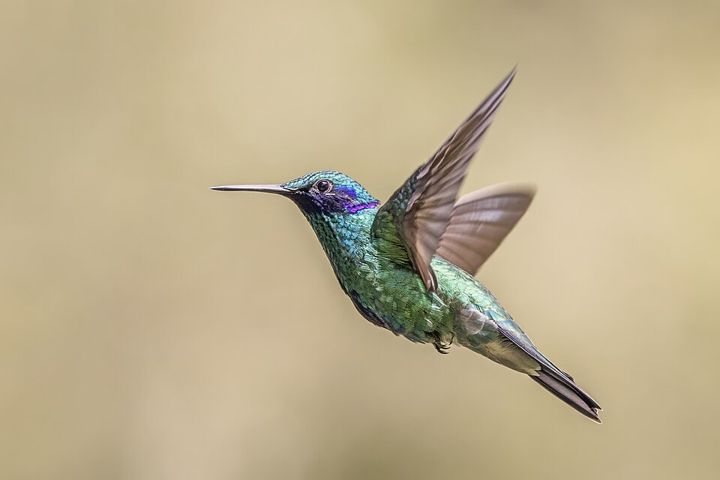
Elsewhere (in East Asia only in bird parks or botanic gardens)
Habitat
towns and gardens, forest
Colour
green, blue, purple
Size
small (under about 20 cm)
IUCN status
Least Concern
IOC breeding range
SA (n, w)
Identification
The largest violetear, 13–14 cm long, males 5.8–8.5 g and females 6–7.5 g. The nominate male is metallic bluish green above with a bluish-violet chin, blue belly and green on the rest of the underparts; long erectile bluish-violet plumes cover the ears, and the tail is metallic green with a steely blue band near the end. Females are similar but smaller, often with a white spot behind the eye. Highly vocal and territorial.
Habitat
A wide range of semi-open habitats including gardens and parks in major cities such as Quito, often the commonest hummingbird in its range; prefers moister places than the lesser violetear.
Distribution
The highlands of northern and western South America: the Andes from Argentina northward, the Venezuelan Coastal Range and the tepuis. Absent from East Asia; Birdwatching Notebook lists it as an exotic.
Season and behaviour
Resident, seen all year within its range, guarding a patch of flowers or a feeder all day.
Photography tips
These are the FilmAnalysis editors' notes, not content from the sources.
It guards one clump of flowers and returns to the same perch: prefocus there, front-lit, 1/2500 s; the raised violet ear plumes show best when it drives off a rival. City parks and hotel gardens are enough, with no need to enter the forest.
Field ethics: keep a distance at which the bird does not change its behaviour; never approach or publish nest sites; no baiting, playback or flash; never clear vegetation around a nest; follow reserve rules and stay on paths.
Photographic styles
A blue-green hummingbird in a city garden; raised violet ears.
Similar species
Lesser violetear (smaller, green not blue belly, no violet chin); brown violetear (brown).
Related badge
None yet. No validated photo recognition exists for this species, so no badge is tied to it: a name in the encyclopedia is not evidence in a photograph.
The illustration is original FilmAnalysis artwork. The photograph is from Wikimedia Commons; its licence and author are under it.