Japan and temperate East Asia, Singapore and tropical Asia
Habitat
coast and mangroves
Colour
red, white, brown
Size
small (under about 20 cm)
IUCN status
Critically Endangered
IOC breeding range
PAL (coastal low Arctic to subarctic tundra of ne Siberia: ne, e Chukotskiy Pen. to n Kamchatka Pen. (ne Russia))
IOC non-breeding range
OR : coastal mudflats from Taiwan and ec China to Bangladesh; mainly Thailand, Myanmar and Bangladesh
Identification
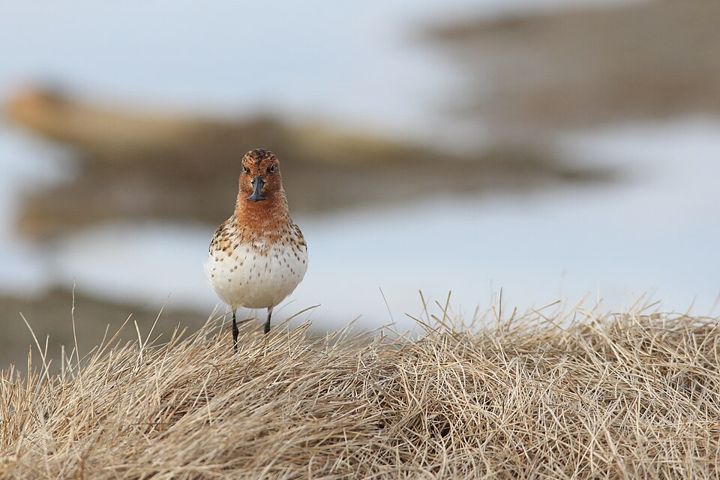
A small wader, 14–16 cm long. Its most distinctive feature is the bill, widening into a spatula 10–12 mm across. Breeding adults have a red-brown head, neck and breast with dark streaks and blackish upperparts fringed buff and pale rufous; non-breeders are pale brownish grey above with whitish fringes to the wing coverts, white below, with black legs. Calls are a quiet preep or a shrill wheer.
Habitat
Breeds on low Arctic to subarctic tundra along the Bering Sea coast; on passage and in winter on coastal mud, salt pans and shrimp ponds, mixed with red-necked stints and other small sandpipers, sweeping the spoon through shallow water and soft mud.
Distribution
Breeds from the Chukotka Peninsula to northern Kamchatka in north-east Siberia; winters on coastal mudflats from Taiwan and eastern China to Bangladesh, mainly in Thailand, Myanmar and Bangladesh. The Jiangsu coast of China (Tiaozini, Dongtai) is the most important staging site; occasionally recorded in Singapore. Only about 240–456 mature individuals remain and it has been listed as critically endangered since 2008.
Season and behaviour
On the Jiangsu coast in April–May and August–October, lingering in autumn; a few winter on the south China coast. Among thousands of small sandpipers it is found by bill shape, most easily at high-tide roosts.
Photography tips
These are the FilmAnalysis editors' notes, not content from the sources.
A critically endangered bird: the first rule is no disturbance. Stay on the bund, use 600 mm or more with a teleconverter, and let it come to you. The spoon shows only head-on or at three-quarters: wait for the moment it lifts its head, 1/1600 s. Tracking it in a mixed flock is hard, so lock on and wait. Never move the surrounding stints for a cleaner background.
Field ethics: keep a distance at which the bird does not change its behaviour; never approach or publish nest sites; no baiting, playback or flash; never clear vegetation around a nest; follow reserve rules and stay on paths.
Photographic styles
A tiny target on the flats; one point of red on grey mud.
Similar species
Red-necked stint (straight bill, red neck in breeding plumage but no spoon, often together); other small sandpipers in non-breeding plumage are told only by bill shape.
Related badge
None yet. No validated photo recognition exists for this species, so no badge is tied to it: a name in the encyclopedia is not evidence in a photograph.
The illustration is original FilmAnalysis artwork. The photograph is from Wikimedia Commons; its licence and author are under it.