Singapore and tropical Asia, Japan and temperate East Asia
Habitat
towns and gardens
Colour
pink, grey, black
Size
medium (20 to 50 cm)
IUCN status
Least Concern
IOC breeding range
OR (widespread)
Identification
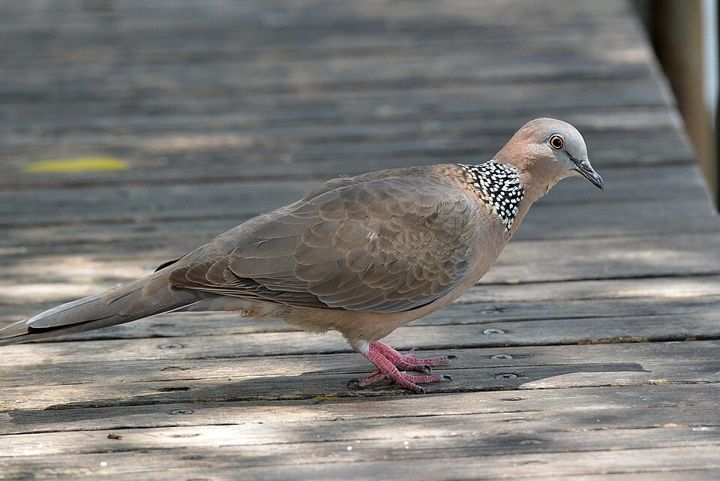
28–32 cm, a long slim dove with a long tail. Rosy buff below shading to grey on the head and belly; a half collar on the back and sides of the neck of forked black feathers each tipped with two white spots, the most reliable mark. Wing feathers dark brown with grey edges, white centre of the belly and vent, and white tips to the outer tail feathers seen on take-off. Sexes alike; juveniles lack the neck spots.
Habitat
Villages, farmland, parks, gardens, roadsides and city greenery, pecking seeds on the ground with a bobbing walk; builds a flimsy twig nest in trees and on buildings.
Distribution
Native to the Indian subcontinent, East and South-East Asia; very common south of the Yangtze and everywhere in Singapore; introduced to Hawaii, Australia and elsewhere, where feral populations are established. Absent from mainland Japan.
Season and behaviour
Resident, seen all year and breeding in most months. The call is a soft three-note coo-coo-croo, most at dawn and dusk.
Photography tips
These are the FilmAnalysis editors' notes, not content from the sources.
The pearl collar is the point: a long lens in side light for the neck detail, and the rosy breast only keeps its colour in soft light. They return to the same tree each evening, when the backlit outline is the picture. On the ground, get down to its level and the grass blurs cleanly in front.
Field ethics: keep a distance at which the bird does not change its behaviour; never approach or publish nest sites; no baiting, playback or flash; never clear vegetation around a nest; follow reserve rules and stay on paths.
Photographic styles
Soft pink-grey portraits; the everyday of yards and lanes.
Similar species
Oriental turtle dove (scaly rufous wing pattern, black-and-white neck stripes rather than spots, common in northern China and Japan); red collared dove (smaller, rufous male, black hind collar).
Related badge
The album badge "a pigeon" unlocks when the vision model explicitly names a a pigeon in your photo and you rate the analysis. The badge stops at "a pigeon": it does not tell species apart, and this page existing unlocks nothing.
The illustration is original FilmAnalysis artwork. The photograph is from Wikimedia Commons; its licence and author are under it.