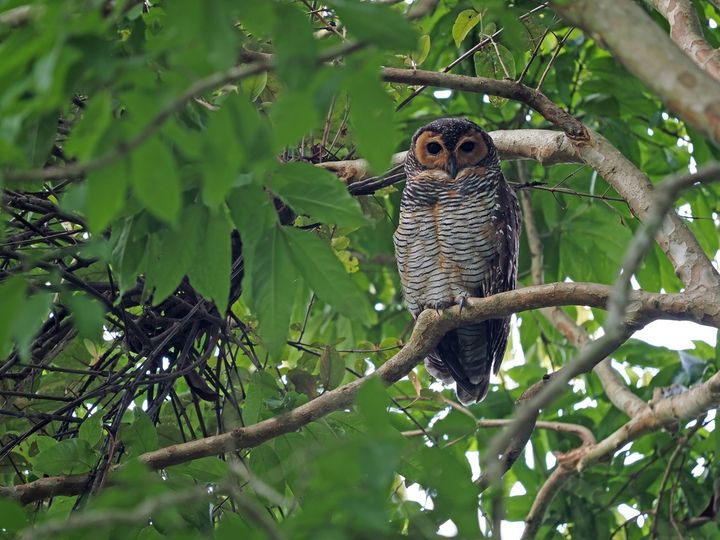
Photo: James Eaton, via iNaturalist, public domain / CC0. Unmodified apart from resizing.
Region
Singapore and tropical Asia
Habitat
forest, towns and gardens, coast and mangroves
Colour
brown, yellow, white
Size
medium (20 to 50 cm)
Identification
44 to 48 cm, with no ear tufts. Chocolate-brown head with an orange-buff facial disc and, in the nominate race, a yellowish throat band; upperparts coffee brown with black-edged white bars and spots; underparts dull yellow with broad white and narrow black bars. Dark brown eyes, greenish-black bill, feathered legs and toes.
Habitat
Lowland forest, mangroves, open woodland, plantations and parks in towns and villages.
Distribution
A broken range around Borneo but not on it: the nominate race from southern Myanmar and central Thailand to Singapore, Jambi (Sumatra) and Java; other races on Bawean and in Palawan and the Calamian Islands.
Season and behaviour
Nocturnal; eats mainly mice and rats, plus insects and small birds. The call is a rolling 'huhuhu' followed by a long 'whoo'. Least Concern on the IUCN Red List.
Photography tips
These are the FilmAnalysis editors' notes, not content from the sources.
By day it rests in the deep shade of tall trees under dappled light: use centre-weighted metering and keep bright gaps of sky out of the frame. It sits still for long periods, so 1/125 s with stabilisation can keep the ISO down. If it stares and stretches itself thin, it is disturbed: step back. No strong lights or flash at night.
Field ethics: keep a distance at which the bird does not change its behaviour; never approach or publish nest sites; no baiting, playback or flash; never clear vegetation around a nest; follow reserve rules and stay on paths.
Photographic styles
Quiet portraits in shade; dappled light.
Similar species
Brown wood owl (redder facial disc, finer barring); buffy fish owl (ear tufts that stick out, yellow eyes).
Related badge
The album badge "an owl" unlocks when the vision model explicitly names a an owl in your photo and you rate the analysis. The badge stops at "an owl": it does not tell species apart, and this page existing unlocks nothing.
The illustration is original FilmAnalysis artwork. The photograph is from iNaturalist; its licence and author are under it.
Why it is listed: this bird is named in the YouTube video description (波遊足跡 EP1) (the description text, not the subtitles). The video only shows that it was mentioned; names follow the IOC World Bird List 15.2 and the facts follow the sources below.