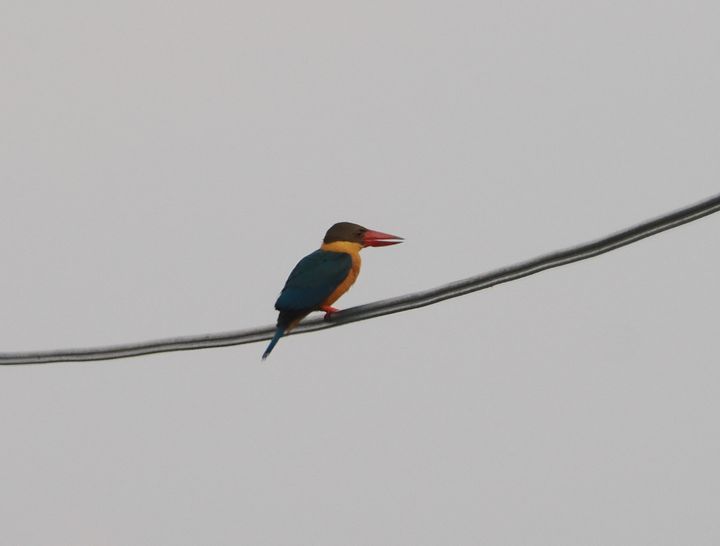
Photo: Tero Linjama, via iNaturalist, public domain / CC0. Unmodified apart from resizing.
Region
Singapore and tropical Asia
Habitat
rivers and wetlands, forest
Colour
blue, green, brown, red
Size
medium (20 to 50 cm)
Identification
About 35 cm, a very large kingfisher. The huge bill and the legs are bright red; the head is olive brown with a paler chin, the neck and underparts buff, the back green and the wings and tail blue. Sexes are alike. Of 13 subspecies most differ only in detail; the Sulu Archipelago race has a white head, neck and underparts.
Habitat
Streams and ponds with tree cover in the lowlands.
Distribution
The tropical Indian subcontinent and Southeast Asia, from India to Indonesia; widespread but sparse.
Season and behaviour
Sedentary all year. The flight looks laboured, with heavy wing-beats, but it flies straight.
Photography tips
These are the FilmAnalysis editors' notes, not content from the sources.
It perches on favourite shaded branches over dark water, so the contrast is high: spot-meter, or dial in −0.3 to −0.7 EV to hold the red bill and pale breast. The bill is the subject, and a side view shows it best. About 500 mm; 1/500 s for perched birds, 1/2000 s or faster for dives.
Field ethics: keep a distance at which the bird does not change its behaviour; never approach or publish nest sites; no baiting, playback or flash; never clear vegetation around a nest; follow reserve rules and stay on paths.
Photographic styles
Documentary portraits in clean blocks of colour; low-key frames against dark water.
Similar species
Common kingfisher (much smaller, dark bill); white-throated kingfisher (also red-billed, but chestnut head and belly with a white throat and breast).
Related badge
The album badge "a kingfisher" unlocks when the vision model explicitly names a a kingfisher in your photo and you rate the analysis. The badge stops at "a kingfisher": it does not tell species apart, and this page existing unlocks nothing.
The illustration is original FilmAnalysis artwork. The photograph is from iNaturalist; its licence and author are under it.
Why it is listed: this bird is named in the YouTube video description (波遊足跡 EP1) (the description text, not the subtitles). The video only shows that it was mentioned; names follow the IOC World Bird List 15.2 and the facts follow the sources below.