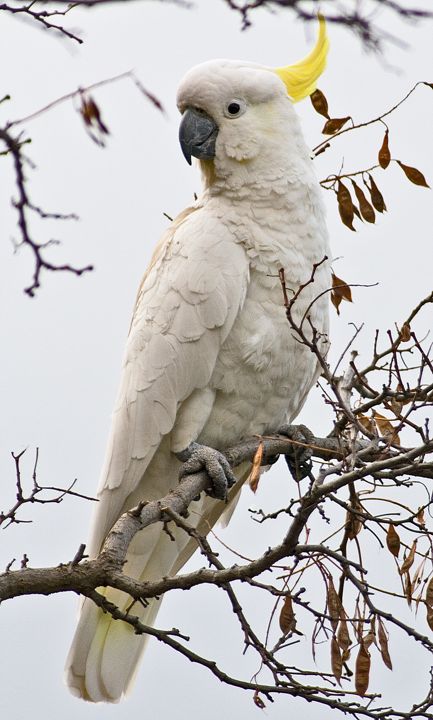
Photo: JJ Harrison (https://www.jjharrison.com.au/), via Wikimedia Commons, licensed CC BY-SA 3.0. Unmodified apart from resizing.
Region
Singapore and tropical Asia
Habitat
towns and gardens
Colour
white, yellow
Size
large (over 50 cm)
IUCN status
Least Concern
IOC breeding range
AU (New Guinea and satellites and n, e Australia and Tasmania)
Identification
A relatively large white cockatoo, 44–55 cm long, the Australian subspecies larger than those of New Guinea. All white with an erectile sulphur-yellow crest and a pale yellow wash under the wings and tail; a heavy black bill and white bare skin round the eye. Loud and raucous, raising the crest when angry or excited. Highly intelligent and long-lived.
Habitat
Woodland, parks and city greenery, so numerous in its native range that it is sometimes considered a pest; nests in tree holes and feeds in flocks in trees and on grass for seeds, fruit, shoots and insects.
Distribution
Native to northern and eastern Australia, Tasmania, New Guinea and some Indonesian islands; introduced to Singapore, where the feral population is estimated at 500–2,000 and it is common in the tall trees of parks and housing estates; also introduced to Palau, New Zealand and Hong Kong. Only escapes in mainland China and Japan.
Season and behaviour
Seen all year in Singapore, screeching through the canopy in flocks morning and evening and feeding on park grass by day. Listed among the balcony birds in Birdwatching Notebook.
Photography tips
These are the FilmAnalysis editors' notes, not content from the sources.
White plumage clips easily in tropical sun: take off a stop and wait for soft light at the edge of shade; the yellow crest opens on landing and when it calls, so shoot bursts then. Singapore's flocks are noisy, so listen before you look for the tree. Against the light the yellow glows through the wings.
Field ethics: keep a distance at which the bird does not change its behaviour; never approach or publish nest sites; no baiting, playback or flash; never clear vegetation around a nest; follow reserve rules and stay on paths.
Photographic styles
A great white bird in tropical shade; the accent of a yellow crest.
Similar species
Yellow-crested cockatoo (smaller, yellower or orange crest, also feral in Singapore); yellow-crowned amazons are green.
Related badge
None yet. No validated photo recognition exists for this species, so no badge is tied to it: a name in the encyclopedia is not evidence in a photograph.
The illustration is original FilmAnalysis artwork. The photograph is from Wikimedia Commons; its licence and author are under it.