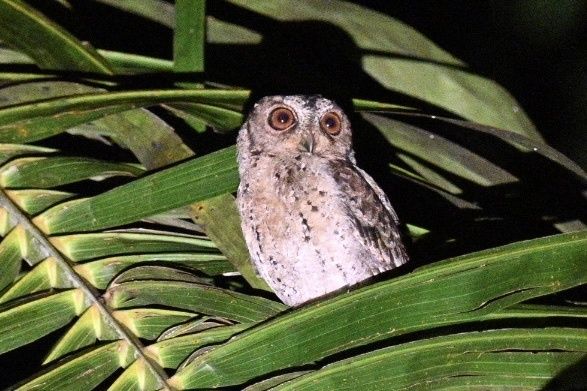
Photo: Лариса Артемьева, via iNaturalist, public domain / CC0. Unmodified apart from resizing.
Region
Singapore and tropical Asia
Habitat
forest, towns and gardens
Colour
brown
Size
medium (20 to 50 cm)
Identification
A small brown owl, 20 to 25 cm and 100 to 170 g, with small ear tufts. Upperparts speckled black, underparts streaked black. A pale collar and dark eyes separate it from the reddish, mountain, Oriental and Rajah scops owls.
Habitat
Mainly forest and gardens; occasionally attracted to buildings.
Distribution
The Malay Peninsula, Singapore, Borneo, Sumatra and Java.
Season and behaviour
Eats mainly insects, also rats, small fish, lizards, crickets and beetle larvae, with rats preferred. Lays up to three eggs in a tree hollow from January to April, sometimes into June or July. The call is a single hoot after long silences; each owl's voice is individual, used to hold its territory.
Photography tips
These are the FilmAnalysis editors' notes, not content from the sources.
By day it hides in a hollow or thick foliage and barely moves; never knock on trunks, shake branches or shine lights into a hollow to bring it out. At night use only a brief, dim red light and no flash, and accept high-ISO noise rather than disturb it. Never publish the location of a nest hollow.
Field ethics: keep a distance at which the bird does not change its behaviour; never approach or publish nest sites; no baiting, playback or flash; never clear vegetation around a nest; follow reserve rules and stay on paths.
Photographic styles
Low-key environmental frames with a small subject.
Similar species
Collared scops owl (slightly larger, orange or brown eyes); Oriental scops owl (yellow eyes).
Related badge
The album badge "an owl" unlocks when the vision model explicitly names a an owl in your photo and you rate the analysis. The badge stops at "an owl": it does not tell species apart, and this page existing unlocks nothing.
The illustration is original FilmAnalysis artwork. The photograph is from iNaturalist; its licence and author are under it.
Why it is listed: this bird is named in the YouTube video description (波遊足跡 EP1) (the description text, not the subtitles). The video only shows that it was mentioned; names follow the IOC World Bird List 15.2 and the facts follow the sources below.