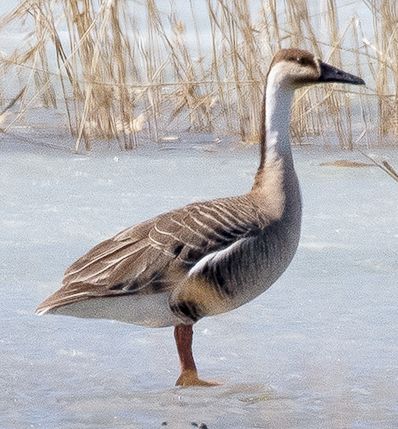
A large, long-necked goose. The crown and hindneck are deep chestnut-brown with a sharp line against the pale foreneck and cheeks; the bill is black, long and straight with a thin white line at its base; the body grey-brown, paler below, the legs orange. It is the wild ancestor of the Chinese domestic goose, but wild birds lack the domestic knob on the forehead.
Habitat
Steppe to taiga near river valleys, lakes and marshes, grazing sedges, grasses and water plants on land and rarely swimming; in winter it grazes plains, lake shores and stubble fields, sometimes far from water.
Distribution
Breeds in inland Mongolia, north-east China and the Russian Far East and winters mainly in central and eastern China, with Poyang Lake and the lakes of the middle and lower Yangtze the most important sites; a vagrant to Japan and Korea, where it once wintered in numbers. Uncommon in the wild but widely domesticated.
Season and behaviour
On the middle and lower Yangtze from October to March, with wintering flocks at Poyang Lake reaching tens of thousands; returns north in April and breeds from May. Small flocks outside the breeding season.
Photography tips
These are the FilmAnalysis editors' notes, not content from the sources.
The grasslands of Poyang and Dongting are the stage: photograph the grazing flocks from a car or hide at long range, where side light shows the line between dark hindneck and pale foreneck. Take-off formations need 1/2000 s. Never put the flock up.
Field ethics: keep a distance at which the bird does not change its behaviour; never approach or publish nest sites; no baiting, playback or flash; never clear vegetation around a nest; follow reserve rules and stay on paths.
Photographic styles
Goose flocks on lake grasslands; flat winter compositions.
Similar species
Bean goose (black bill with an orange band, no two-tone neck); greylag (pink bill, grey body); the domestic Chinese goose has a knob on the forehead.
Related badge
The album badge "a duck" unlocks when the vision model explicitly names a a duck in your photo and you rate the analysis. The badge stops at "a duck": it does not tell species apart, and this page existing unlocks nothing.
The illustration is original FilmAnalysis artwork. The photograph is from Wikimedia Commons; its licence and author are under it.