Japan and temperate East Asia, Singapore and tropical Asia
Habitat
towns and gardens, forest
Colour
green, yellow, white
Size
small (under about 20 cm)
IUCN status
Least Concern
IOC breeding range
OR (e China, Taiwan and n Vietnam to Thai-Malay Pen. to Sumatra and Borneo)
IOC non-breeding range
to c Indochina
Identification
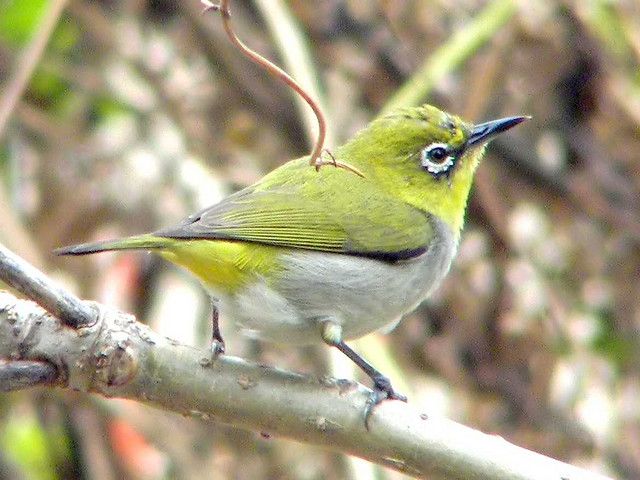
A small white-eye of about 11 cm. Yellow-green above, yellow on the throat and undertail, grey-white on the breast and belly, with a bold ring of white feathers round the eye; the small bill is slightly decurved, the legs grey. Sexes alike. Formerly placed under the Japanese white-eye and now a species of its own.
Habitat
Parks, gardens, orchards, secondary forest and mangroves, moving fast in flocks through blossom and canopy, taking nectar and small fruit and often hanging upside down on flowers.
Distribution
Eastern China, Taiwan and northern Vietnam to the Thai-Malay Peninsula, Sumatra and Borneo; introduced to Southern California, where it is spreading fast. Common in gardens across south-east China and Singapore; mainland Japan has the related Japanese white-eye.
Season and behaviour
Resident, seen all year. In spring it concentrates on cherry, cotton-tree and other red blossom for nectar, the easiest time of year; the call is a thin tsee.
Photography tips
These are the FilmAnalysis editors' notes, not content from the sources.
It never stays, but it does spend two or three seconds on one flower: prefocus on the blossom, 1/1000 s or faster, and bursts. Keep the white eye-ring sharp, so do not open the aperture fully. Against the light the yellow-green plumage glows, and blossom as a soft foreground is the classic Japanese-style picture.
Field ethics: keep a distance at which the bird does not change its behaviour; never approach or publish nest sites; no baiting, playback or flash; never clear vegetation around a nest; follow reserve rules and stay on paths.
Photographic styles
High-key Japanese style of flowers and a small bird; bright yellow-green.
None yet. No validated photo recognition exists for this species, so no badge is tied to it: a name in the encyclopedia is not evidence in a photograph.
The illustration is original FilmAnalysis artwork. The photograph is from Wikimedia Commons; its licence and author are under it.