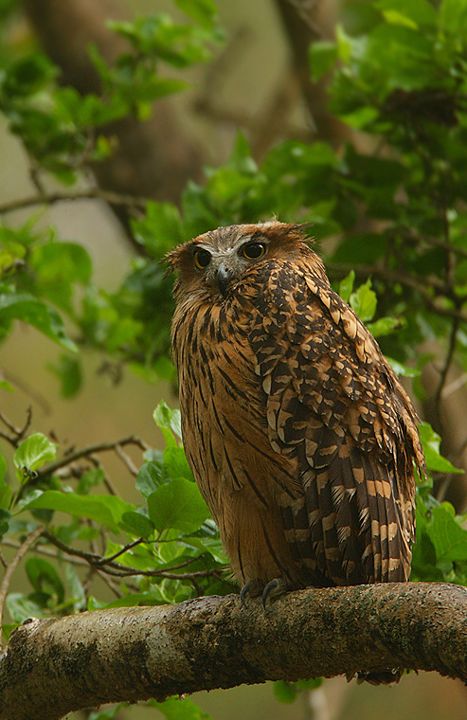
A large fish owl with big loose ear tufts that usually hang to the sides of the head, distinctly messy and tousled; yellow eyes. Crown and upperparts orange-rufous with broad blackish central markings and reddish-brown edges spotted the same colour; the scapulars dingy yellow, forming a contrasting band across the shoulders; flight and tail feathers strongly barred dark brown and buff. The facial disc is poorly defined, but a sizeable off-white area on the brows and forehead stands out. Called the most attractive of the fish owls; the legs are feathered halfway.
Habitat
Streams, rivers and lake shores in hill forest, perching in big waterside trees and taking fish, crabs and frogs from the shallows and banks at night; breeds in tree holes, on cliff ledges and in the old nests of other raptors.
Distribution
From southern Nepal, Bhutan and Bangladesh through Myanmar and Vietnam to China, on hill streams of southern, central and south-western China to Taiwan, with records from Henan and southern Shaanxi. Absent from Japan and Singapore. Widespread; least concern.
Season and behaviour
Resident, seen all year; breeds from November to February, with deep hoots on winter nights. Dusk by a stream is its hour.
Photography tips
These are the FilmAnalysis editors' notes, not content from the sources.
At dusk it waits for fish on a branch or rock over the stream: a long lens and tripod across the water at 1/125–1/250 s with stabilisation, and no light. The orange-rufous darkens in twilight, so place it against water reflecting the sky. The tousled tufts and yellow eyes are the point. Avoid the nest area entirely.
Field ethics: keep a distance at which the bird does not change its behaviour; never approach or publish nest sites; no baiting, playback or flash; never clear vegetation around a nest; follow reserve rules and stay on paths.
Photographic styles
A great owl in stream twilight; orange-rufous low-light portraits.
Similar species
Brown fish owl (mainly brown, bare legs, southern China and South-East Asia); buffy fish owl (smaller and yellower, tropics, Singapore); Blakiston's fish owl (larger, fully feathered legs, north-east and Hokkaido).
Related badge
The album badge "an owl" unlocks when the vision model explicitly names a an owl in your photo and you rate the analysis. The badge stops at "an owl": it does not tell species apart, and this page existing unlocks nothing.
The illustration is original FilmAnalysis artwork. The photograph is from Wikimedia Commons; its licence and author are under it.