Elsewhere (in East Asia only in bird parks or botanic gardens)
Habitat
towns and gardens
Colour
black, orange, white
Size
large (over 50 cm)
IUCN status
Least Concern
IOC breeding range
SA (ne, c, se)
Identification
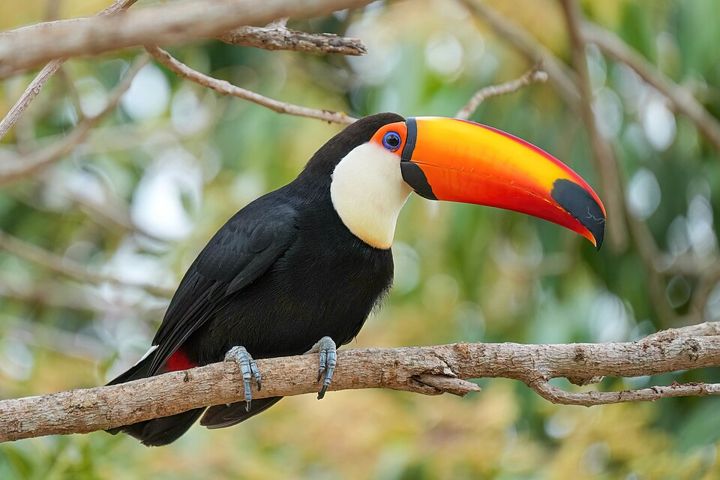
The largest toucan, averaging 56 cm long. Glossy black body, white throat and chest (sometimes with a citrine tint and a red band), white uppertail coverts and red undertail coverts. Its most conspicuous feature is the huge yellow-orange bill with a black base and a large black spot at the tip. Brown eye in a narrow blue ring with sulphur-yellow to orange bare skin around it. Unmistakable.
Habitat
Unlike most toucans of the deep rainforest, it prefers open and semi-open country: savanna, woodland, gallery forest and plantations, nesting in tree holes and eating fruit, insects and the eggs and chicks of other birds.
Distribution
Endemic to South America from the Guianas south to northern Argentina and Uruguay, its range expanding southward in recent years. In East Asia seen only in zoos and bird parks, including Singapore's; Birdwatching Notebook lists it as an exotic.
Season and behaviour
Seen all year in bird parks; resident in the wild.
Photography tips
These are the FilmAnalysis editors' notes, not content from the sources.
The bill is the focus and only a profile shows its length and black spot, the orange most saturated in front light. Black body against orange bill is extreme contrast: meter on the bill and add a third of a stop. Park birds use fixed perches, so a medium lens is enough; do not feed it closer. Label it captive.
Field ethics: keep a distance at which the bird does not change its behaviour; never approach or publish nest sites; no baiting, playback or flash; never clear vegetation around a nest; follow reserve rules and stay on paths.
Photographic styles
Big blocks of orange and black; the profile of a giant bill.
Similar species
Other toucans (different bill colours, smaller); South-East Asian hornbills have a casque and are unrelated.
Related badge
None yet. No validated photo recognition exists for this species, so no badge is tied to it: a name in the encyclopedia is not evidence in a photograph.
The illustration is original FilmAnalysis artwork. The photograph is from Wikimedia Commons; its licence and author are under it.