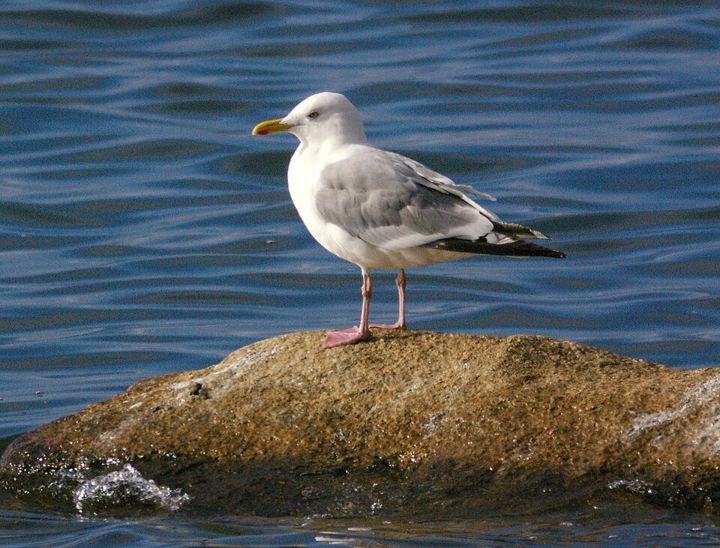
Photo: ALAN SCHMIERER, via Wikimedia Commons, public domain / CC0. Unmodified apart from resizing.
Region
Japan and temperate East Asia
Habitat
coast and mangroves
Colour
white, grey, pink
Size
large (over 50 cm)
IOC breeding range
PAL (Arctic c, e Siberia from Taimyr to Chukotka, New Siberian Is. (far nc Russia) and St. Lawrence I. (n Bering Sea))
IOC non-breeding range
to coasts of Japan, Korean Pen. and e China
Identification
A large gull of the herring-gull complex whose classification is still debated. Like the European herring gull but slightly darker grey above; in winter the head is heavily streaked brown, forming a collar on the hindneck; the legs are usually bright pink; the bill yellow with a red spot; the eye variable but usually dark with a red orbital ring. First- and second-winter birds are darker and more heavily flecked than the similar Mongolian gull.
Habitat
Coasts, harbours, estuaries, fish markets and refuse tips, gathering in winter in fishing ports and following the boats.
Distribution
Breeds in the Arctic of central and eastern Siberia from the Taymyr to Chukotka, the New Siberian Islands and St Lawrence Island in the Bering Sea; winters on the coasts of Japan, Korea and eastern China and is one of the commonest large gulls in Japanese fishing ports in winter. Absent from Singapore.
Season and behaviour
On the coasts of Japan and eastern China from November to March; the head streaking fades from March. Often with slaty-backed and black-tailed gulls on breakwaters and boats.
Photography tips
These are the FilmAnalysis editors' notes, not content from the sources.
Large gulls are identified by detail: get the wingtip pattern and leg colour sharp, front-lit, at eye level, 1/1000 s. Harbour flocks are tame, so a medium telephoto frames them among masts and ropes; the morning fish landing is the liveliest time. The brown winter collar is the mark to show.
Field ethics: keep a distance at which the bird does not change its behaviour; never approach or publish nest sites; no baiting, playback or flash; never clear vegetation around a nest; follow reserve rules and stay on paths.
Photographic styles
Grey-and-white documentary of fishing ports; gulls and rigging.
The album badge "a gull" unlocks when the vision model explicitly names a a gull in your photo and you rate the analysis. The badge stops at "a gull": it does not tell species apart, and this page existing unlocks nothing.
The illustration is original FilmAnalysis artwork. The photograph is from Wikimedia Commons; its licence and author are under it.