OR (Himalayas from Pakistan to ec China, se Asia, Sumatra and Borneo)
Identification
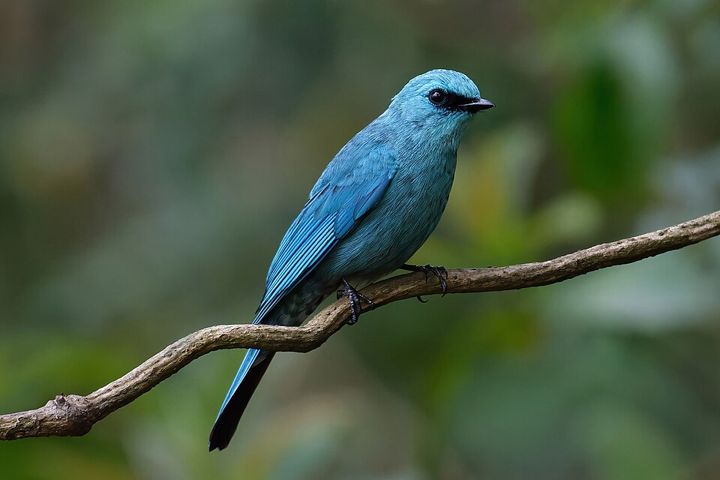
Named for its distinctive copper-sulphate blue. The adult male is intense blue over the whole body except for a black patch between the eyes and bill and a grey vent; adult females and sub-adults are a lighter, greyer blue. Unlike most flycatchers it hunts flying insects in the open space above the canopy rather than in the understorey.
Habitat
Montane broadleaf and pine forest, forest edge, tea gardens and big trees at village edges, perching on high branches, wires and dead twigs and returning to the same perch after each sally.
Distribution
From Pakistan along the Himalayas to east-central China, South-East Asia, Sumatra and Borneo; a summer visitor or resident in the hills of south-west, central and southern China, very common in Yunnan and Sichuan. A rare passage migrant in Singapore; absent from Japan.
Season and behaviour
Breeds in the hills of southern China from April to September, the male singing persistently from a high perch; descends and moves to South-East Asia in winter. Sits on dead twig tips for long spells.
Photography tips
These are the FilmAnalysis editors' notes, not content from the sources.
It perches high and long, so shoot with a long lens from slightly below; against the sky the blue goes grey, and only a dark green hillside behind saturates it, with front light essential. Its sally and return follow a fixed path: prefocus on the perch and wait for it to come back, 1/1600 s.
Field ethics: keep a distance at which the bird does not change its behaviour; never approach or publish nest sites; no baiting, playback or flash; never clear vegetation around a nest; follow reserve rules and stay on paths.
Photographic styles
One point of copper-blue against a dark green slope; portraits on a dead twig.
Similar species
Males of blue-throated and blue-and-white flycatchers (white or orange below, not all blue); Hainan blue flycatcher (orange below).
Related badge
None yet. No validated photo recognition exists for this species, so no badge is tied to it: a name in the encyclopedia is not evidence in a photograph.
The illustration is original FilmAnalysis artwork. The photograph is from Wikimedia Commons; its licence and author are under it.