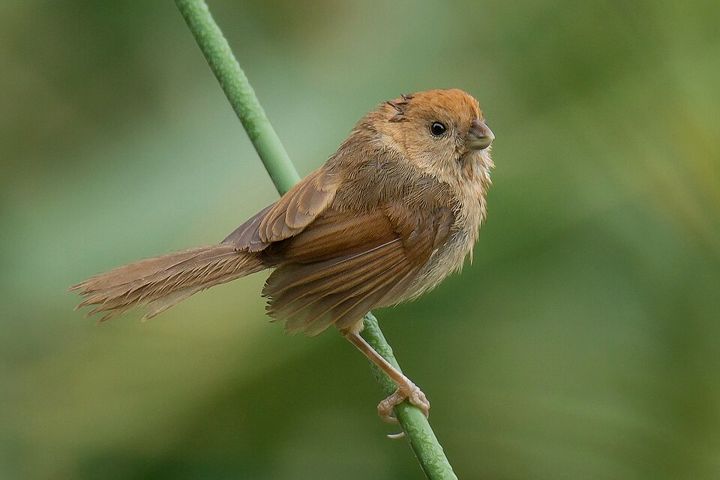
Photo: Wich’yanan (Jay) Limparungpatthanakij, via Wikimedia Commons, licensed CC BY 4.0. Unmodified apart from resizing.
Region
Japan and temperate East Asia
Habitat
towns and gardens, forest
Colour
brown, pink, grey
Size
small (under about 20 cm)
IUCN status
Least Concern
IOC breeding range
PAL (e, also Taiwan, s China, nw Vietnam)
Identification
A relatively small, long-tailed parrotbill about 12 cm long. Rufous-brown crown and neck sides, brown upperparts with chestnut-edged wing feathers; throat and breast pale vinous pink with fine streaks, belly pale buff. The bill is very short and deep like a parrot's, yellowish brown; small brown eye. Known in Taiwan as the pink parrot-bill. Always in flocks and never silent.
Habitat
Extremely adaptable: scrub, secondary woodland of every stage, forest edge, bamboo, hedges, reeds and marshes, also tea plantations, nurseries and city parks; replaced above 1,000 m in Sichuan by the ashy-throated parrotbill, while in Taiwan it ranges from sea level to 3,100 m.
Distribution
Across eastern Asia from northern Vietnam to southern Manchuria, one of the commonest small birds in the scrub of eastern, central and southern China; also Korea, the Russian Far East and Taiwan. Absent from Japan and Singapore.
Season and behaviour
Resident, seen all year; in winter flocks of dozens work through scrub and reeds with a constant chittering; breeds from April to July in a small cup nest in a bush.
Photography tips
These are the FilmAnalysis editors' notes, not content from the sources.
As a flock passes, one or two always climb to the top of the bush to look: prefocus on the highest twig and shoot bursts at 1/1000 s. The pink breast shows only in soft light and bleaches in sun. They are not shy, so crouching at the edge of the scrub and letting the flock come round works better than following.
Field ethics: keep a distance at which the bird does not change its behaviour; never approach or publish nest sites; no baiting, playback or flash; never clear vegetation around a nest; follow reserve rules and stay on paths.
Photographic styles
Small round faces on bush tops; warm brown-pink.
Similar species
Ashy-throated parrotbill (grey throat, high Sichuan); brown-winged parrotbill (brown crown, no pink, Yangtze basin); reed parrotbill (yellow bill, streaked sides, reeds only).
Related badge
None yet. No validated photo recognition exists for this species, so no badge is tied to it: a name in the encyclopedia is not evidence in a photograph.
The illustration is original FilmAnalysis artwork. The photograph is from Wikimedia Commons; its licence and author are under it.