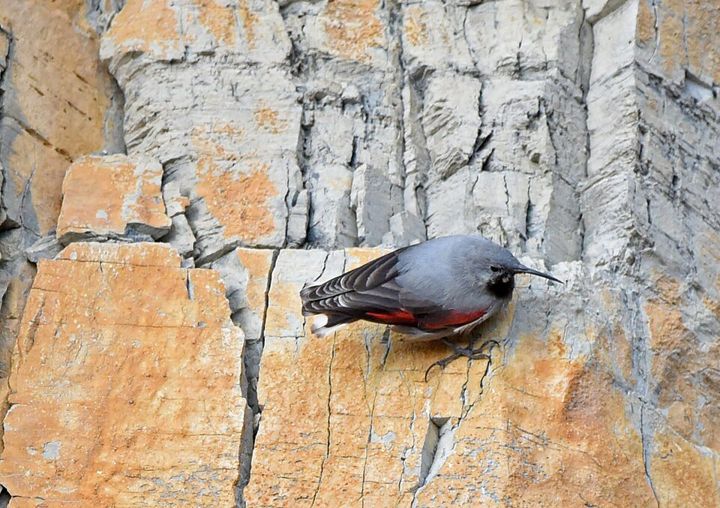
15.5–17 cm long, 17–19 g, the only living member of its family. Mainly blue-grey with darker flight and tail feathers; its most striking feature is the crimson wings spotted with white, largely hidden when folded, the colour covering most of the coverts and the basal half of the primaries and secondaries. In summer the male has a black throat and the female a white throat or a small dark patch; in autumn and winter both are white-throated. Short black tail with a narrow white fringe. A long thin downcurved bill.
Habitat
A bird of high mountains: cliffs, rock faces, gorges and quarries, hopping up the rock like a butterfly and constantly half-opening its wings to flash red; in winter it descends to low rock faces, dams and even the stone walls of old buildings.
Distribution
The high mountains from southern Europe through south-west Asia to central China; in China in Xinjiang, Tibet, Qinghai, Gansu, Ningxia, Inner Mongolia, Sichuan, the north-east, north and centre as far as the hills of Fujian and Guangdong, with winter birds in the hills around Beijing. Absent from Japan and Singapore.
Season and behaviour
Breeds high in the mountains of northern and western China from April to August; from October to March it comes down to low rock faces, reservoir dams and city walls, easiest to photograph on winter cliffs in Beijing and Hebei.
Photography tips
These are the FilmAnalysis editors' notes, not content from the sources.
It hops over the rock face with the wings flicking open and shut, and the red appears only for a fraction of a second: 1/2000 s and bursts. Its grey matches the rock, so there is colour only in the instant of the open wing. In winter it visits dams and walls: a long lens from a distance, no playback, and never close enough to drive it off the face it is feeding on.
Field ethics: keep a distance at which the bird does not change its behaviour; never approach or publish nest sites; no baiting, playback or flash; never clear vegetation around a nest; follow reserve rules and stay on paths.
Photographic styles
A flash of red on grey rock; vertical compositions of climbing.
Similar species
No similar species; the red wings are unique. Treecreepers are brown and do not climb rock.
Related badge
None yet. No validated photo recognition exists for this species, so no badge is tied to it: a name in the encyclopedia is not evidence in a photograph.
The illustration is original FilmAnalysis artwork. The photograph is from Wikimedia Commons; its licence and author are under it.