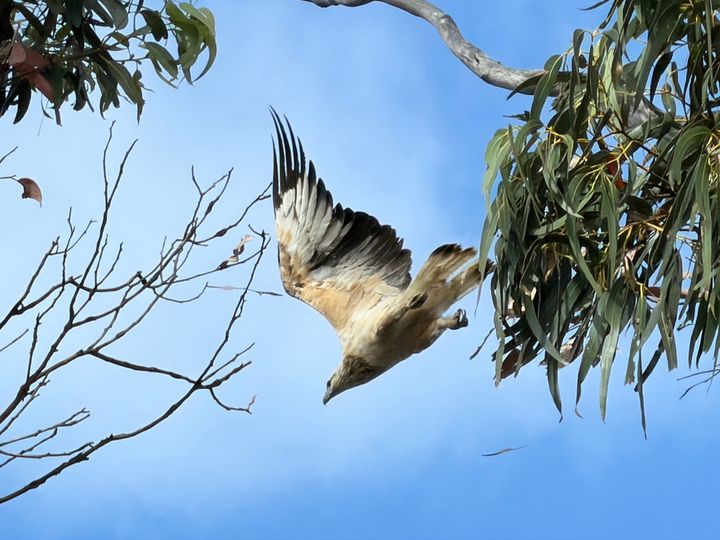
Photo: jstarspots, via iNaturalist, public domain / CC0. Unmodified apart from resizing.
Region
Singapore and tropical Asia
Habitat
coast and mangroves
Colour
white, grey, black
Size
large (over 50 cm)
IOC breeding range
OR, AU (India to e China, Philippines, Indonesia, New Guinea and satellites, Australia (except c), Tasmania and Bismarck Arch.)
Identification
A large diurnal raptor. Adults have a white head, rump and underparts and dark slate-grey back and wings; from below in flight the black flight feathers contrast with the white underwing coverts; the tail is short and wedge-shaped. The large hooked bill is leaden blue-grey with a darker tip, the iris dark brown, the unfeathered legs and feet yellow or grey with long black talons. Males 66–80 cm and 1.8–3 kg, females 80–90 cm and 2.5–4.5 kg, wingspan 1.78–2.2 m. Juveniles are brown and take years to reach adult plumage.
Habitat
Coasts, estuaries, islands, reservoirs and big rivers, building a huge nest in a tall waterside tree and adding to it year after year; takes fish, sea snakes, waterbirds and carrion, often snatching fish in a low pass over the water.
Distribution
India and South-East Asia to the south-east China coast, the Philippines, Indonesia, New Guinea and Australia except the centre. Singapore is one of the easiest cities in which to see it, common over the coast, the reservoirs and the towers, with several breeding pairs; scarce on the south China coast; absent from Japan.
Season and behaviour
Seen all year in Singapore, breeding between May and October, when the pair's goose-like duet carries far at dawn; circling over the reservoirs and stooping for fish is the daily routine.
Photography tips
These are the FilmAnalysis editors' notes, not content from the sources.
Singapore's reservoirs and coasts are the stage: continuous focus as it circles, 1/2500 s for the stoop, and a stop under against the light so the white belly does not clip. The white and dark grey are softest under cloud. Near a nest tree use a long lens from far off, especially in the breeding season.
Field ethics: keep a distance at which the bird does not change its behaviour; never approach or publish nest sites; no baiting, playback or flash; never clear vegetation around a nest; follow reserve rules and stay on paths.
Photographic styles
A great black-and-white bird over water; the breadth of a tropical coast.
Similar species
Osprey (smaller, black carpal patches below, M-shaped wings); brahminy kite (chestnut body, white head, the same coasts); white-tailed eagle (brown with only a white tail, northern).
Related badge
None yet. No validated photo recognition exists for this species, so no badge is tied to it: a name in the encyclopedia is not evidence in a photograph.
The illustration is original FilmAnalysis artwork. The photograph is from iNaturalist; its licence and author are under it.