OR, AU (Pakistan and Maldives through e China, Philippines, Wallacea and Indonesian Arch.)
Identification
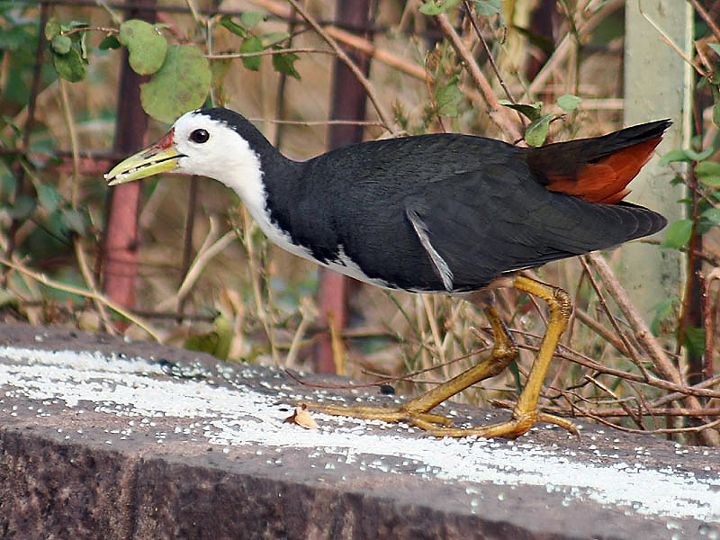
About 32 cm. Dark slaty grey above and on the flanks, with a clean white face, foreneck and breast and a cinnamon lower belly and undertail; yellow bill and legs, long toes, a short tail often cocked upright. The body is flattened sideways for slipping through reeds and undergrowth. Juveniles are a duller version of the adult; chicks are black.
Habitat
Marshes, ponds, ditches, river banks and paddies; bolder than most rails, it steps slowly through open marsh and even roadside drains, and is common on park and housing-estate lawns in Singapore.
Distribution
Widespread in South and South-East Asia, from Pakistan and the Maldives through India and Sri Lanka to eastern and southern China, the Philippines, Wallacea and the Indonesian archipelago; in Japan only on the southern islands. One of Singapore's commonest waterbirds.
Season and behaviour
Resident and seen all year in the tropics. Mostly crepuscular; after the first rains of the breeding season it gives loud, repeated croaking calls.
Photography tips
These are the FilmAnalysis editors' notes, not content from the sources.
It walks slowly with its tail up and is not shy: get low and let the white face and breast become the bright point against dark vegetation, watching that the white does not clip. After rain the calling is loudest and the open bill is the moment. Black chicks crossing the grass need quiet bursts.
Field ethics: keep a distance at which the bird does not change its behaviour; never approach or publish nest sites; no baiting, playback or flash; never clear vegetation around a nest; follow reserve rules and stay on paths.
Photographic styles
Black and white against deep green; everyday city wetlands.
Similar species
Common moorhen (all black, red shield); ruddy-breasted crake (grey below, red legs, far more secretive).
Related badge
None yet. No validated photo recognition exists for this species, so no badge is tied to it: a name in the encyclopedia is not evidence in a photograph.
The illustration is original FilmAnalysis artwork. The photograph is from Wikimedia Commons; its licence and author are under it.