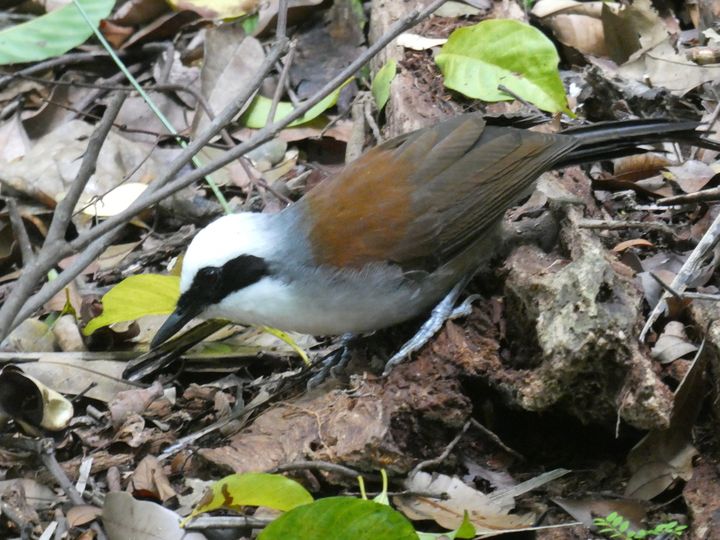
Photo: khopkins63, via iNaturalist, public domain / CC0. Unmodified apart from resizing.
Region
Singapore and tropical Asia
Habitat
forest, towns and gardens
Colour
white, brown, black, grey
Size
medium (20 to 50 cm)
Identification
About 30 cm with a 13 to 15 cm tail; stocky, with strong blackish legs and bill and a rounded tail. White hood, throat and upper breast with a raised fluffy white crest and a broad, long black eye-mask; light grey nape; rufous mantle, back and underparts from the lower breast, darkening to olive brown on the wings and tail. Females have a smaller crest and a duller mantle.
Habitat
Foothill forest up to 1,600 m, favouring dense, damp, shady thickets, the edge and understorey of broadleaf secondary forest, and bamboo; it usually leaves cover only to feed.
Distribution
From the Himalayan foothills to Southeast Asia; also recorded in Singapore.
Season and behaviour
Very social and loud. Small parties hop over the ground, flicking leaf litter aside for beetles, spiders, caterpillars and snails; it also eats fruit, seeds, nectar and even small snakes, lizards and frogs. In Singapore, observers have seen it pick at human food and rubbish.
Photography tips
These are the FilmAnalysis editors' notes, not content from the sources.
You usually hear the laughing chorus before you see the flock turning leaves on the forest floor. The light is dim and the white head against the black mask is extreme contrast: spot-meter on the white so it holds, and lift the shadows later. Get low for an eye-level view; they move fast, so 1/800 s or quicker. Do not feed them.
Field ethics: keep a distance at which the bird does not change its behaviour; never approach or publish nest sites; no baiting, playback or flash; never clear vegetation around a nest; follow reserve rules and stay on paths.
Photographic styles
High-contrast head portraits; scenes of a feeding flock.
Similar species
Other laughingthrushes in the genus are mostly brown; the white crest with a black mask is unmistakable.
Related badge
None yet. No validated photo recognition exists for this species, so no badge is tied to it: a name in the encyclopedia is not evidence in a photograph.
The illustration is original FilmAnalysis artwork. The photograph is from iNaturalist; its licence and author are under it.
Why it is listed: this bird is named in the YouTube video description (波遊足跡 EP1) (the description text, not the subtitles). The video only shows that it was mentioned; names follow the IOC World Bird List 15.2 and the facts follow the sources below.