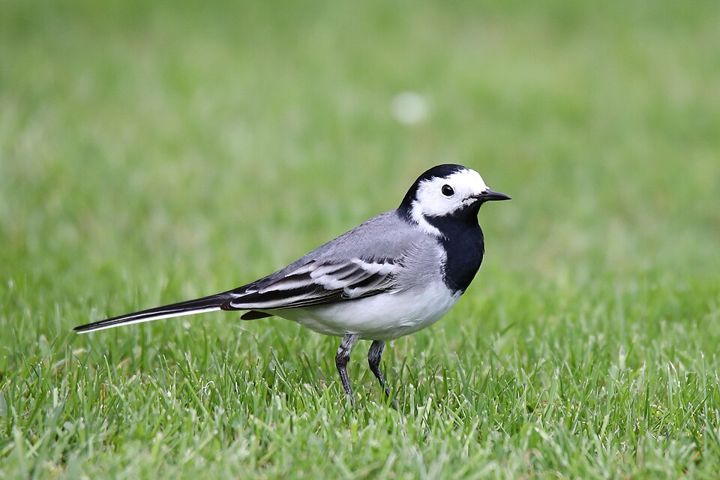
Photo: Jac. Janssen from BAARLO LB, NL, via Wikimedia Commons, licensed CC BY 2.0. Unmodified apart from resizing.
Region
Japan and temperate East Asia, Singapore and tropical Asia
Habitat
rivers and wetlands, towns and gardens
Colour
white, black, grey
Size
small (under about 20 cm)
IUCN status
Least Concern
IOC breeding range
PAL (widespread, also w Alaska)
IOC non-breeding range
OR, AF
Identification
A slender bird of 16.5–19 cm, up to 21 cm in the East Asian subspecies. Black, white and grey: black crown and throat, white face, grey or black back by subspecies, white underparts; the long tail wags constantly, the mark of the whole genus. The flight is deeply undulating and it calls as it goes. Females and juveniles have paler black areas.
Habitat
Open country, often near people and water: river beds, field edges, car parks, roofs and playgrounds. It feeds on bare ground where it can see and chase insects, and has fully adapted to towns.
Distribution
Breeds across most of the Palearctic, in Europe, Asia and parts of North Africa, with a few in western Alaska; resident in the mildest parts and otherwise migrating to Africa and southern Asia. Present all year in China and Japan; a scarce winter visitor to Singapore.
Season and behaviour
Seen all year in China and Japan, more in winter, when dozens roost together on roofs or in trees. It eats insects, running and stopping on the ground, and gives a sharp chissick in flight.
Photography tips
These are the FilmAnalysis editors' notes, not content from the sources.
It never stays still on the ground, so shoot bursts and wait for the pause; a dark water or wetland background brings out the black and white. Puddles in car parks and river beds after rain give reflections. The winter evening roost is another subject: silhouettes from a distance with a long lens.
Field ethics: keep a distance at which the bird does not change its behaviour; never approach or publish nest sites; no baiting, playback or flash; never clear vegetation around a nest; follow reserve rules and stay on paths.
Photographic styles
Small black-and-white studies; nature inside the city.
Similar species
Grey wagtail (yellow below, longer tail, on streams); Japanese wagtail (black face with only a white brow, endemic to Japan).
Related badge
None yet. No validated photo recognition exists for this species, so no badge is tied to it: a name in the encyclopedia is not evidence in a photograph.
The illustration is original FilmAnalysis artwork. The photograph is from Wikimedia Commons; its licence and author are under it.