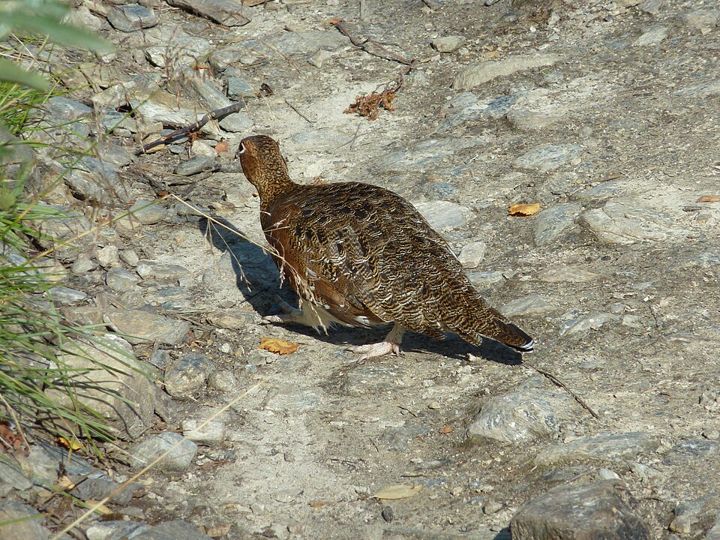
A medium-to-large ground-dwelling grouse, the sexes about equal, 35–44 cm long, wingspan 60–65 cm, 430–810 g. Deep-chested with a fairly long neck, broad bill, short feathered legs and a short rounded tail. In summer the male is marbled brown with a reddish neck and breast, black tail and white wings and underparts, with red semicircular combs over the eyes that become prominent when breeding; the female is similar with small combs. In winter the body and central tail feathers turn white, only the tail black. The most numerous of the three ptarmigans.
Habitat
Northern birch forest, shrub tundra and moorland, browsing willow and birch buds and shoots in winter and burrowing into snow to roost.
Distribution
Breeds in northern Europe, the Scandinavian tundra, Siberia, Alaska and Canada; across northern Eurasia to Mongolia, Ussuriland and Sakhalin. In China in the Greater Khingan range of Heilongjiang and northern Inner Mongolia, a second-class protected species; absent from Japan (Honshu's alpine bird is the rock ptarmigan) and Singapore. The state bird of Alaska.
Season and behaviour
Easiest in the Greater Khingan in winter, white flocks on snow from November to March; hidden in scrub in summer.
Photography tips
These are the FilmAnalysis editors' notes, not content from the sources.
In winter plumage only the black eye, black tail and red comb remain on the snow: add a stop and a half and focus on the eye, best in soft snow light. Tracks and roosting burrows in the snow lead you to them. In extreme cold keep batteries and fingers warm and shoot with a long lens from the car.
Field ethics: keep a distance at which the bird does not change its behaviour; never approach or publish nest sites; no baiting, playback or flash; never clear vegetation around a nest; follow reserve rules and stay on paths.
Photographic styles
A near-invisible white bird on the snowfield; one point of red comb.
Similar species
Rock ptarmigan (slightly smaller, winter male with a black eye-stripe, higher and further north); female black grouse (brown, never white in winter).
Related badge
None yet. No validated photo recognition exists for this species, so no badge is tied to it: a name in the encyclopedia is not evidence in a photograph.
The illustration is original FilmAnalysis artwork. The photograph is from Wikimedia Commons; its licence and author are under it.