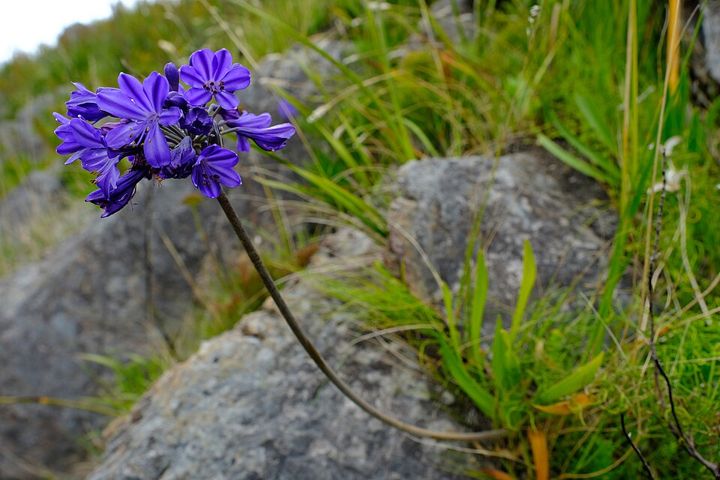
A rhizomatous evergreen geophyte 25–70 cm tall. Leathery suberect long strap leaves. Broadly funnel-shaped flowers, pale to deep blue and thick-textured with a dark blue stripe down the centre of each tepal, 25–40 mm long, in large terminal umbels on long scapes like a blue firework. Flowers from November to April at home, especially after fire, resprouting from thick rhizomes. Pollinated by wind, bees and sunbirds. Called lily of the Nile though it grows only in South Africa. Most garden agapanthus are the hardier Agapanthus praecox and hybrids, often mislabelled as this species.
Habitat
Rocky sandstone slopes of the winter-rainfall fynbos at home; a perennial for borders, roadsides and pots.
Distribution
Native only to a narrow stretch from the Cape Peninsula to Swellendam in South Africa; grown in borders and verges in eastern and southern China (common on Shanghai and Hangzhou streets in summer), common in Japanese beds and verges (agapansasu), scarce in Singapore.
Season and behaviour
November to April at home (peak December to February); June and July in East Asia at the end of the rainy season. One umbel lasts two or three weeks.
Photography tips
These are the FilmAnalysis editors' notes, not content from the sources.
The blue firework wants eye level or a little below, the round umbel against sky or a pale background; blue is truest under cloud and shifts purple in sun. Macro for the dark blue stripe at the centre of a single funnel. Rows of scapes compress with a long lens. The green seed head after flowering is another ball worth a frame.
Photographic styles
A blue firework at eye level; macro of the dark stripe on a tepal.
Similar species
Agapanthus praecox (taller, commoner, similar colour); ornamental alliums (small dense flowers); blue daze and other small blue flowers.
Related badge
None yet. No validated photo recognition exists for this species, so no badge is tied to it: a name in the encyclopedia is not evidence in a photograph.
The illustration is original FilmAnalysis artwork. The photograph is from Wikimedia Commons; its licence and author are under it.
Why it is listed: this species comes from the Flower checklist (GBIF backbone and Wikidata verified). Names follow the GBIF backbone and Wikidata; the facts follow the sources below; photo recognition is not offered.