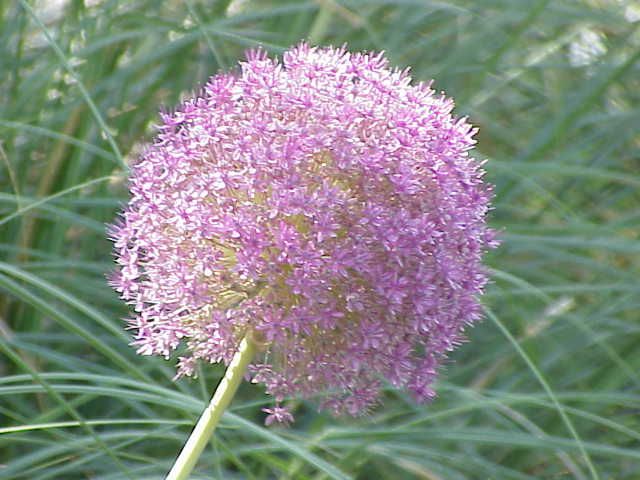
The tallest Allium in common cultivation, up to 1.5 m. Basal broad strap grey-green leaves, often yellowing by flowering time. In early summer a straight scape carries a tight globe 10–15 cm across of hundreds of small star-shaped deep purple flowers, like a purple lollipop; the seed head keeps the globe and dries well. The popular cultivar Globemaster is shorter (80 cm) with a larger globe. Flowers, seeds, leaves and stems contain sulphides that cause nausea, vomiting and diarrhoea if eaten.
Habitat
Well-drained sunny borders and meadow gardens; dry mountain grassland in Central Asia at home.
Distribution
Native to central and south-western Asia (Iran, Afghanistan, Turkmenistan, Tajikistan, Uzbekistan); grown as a spring-planted bulb in borders in northern and eastern China (common at Beijing and Shanghai flower shows), common in Japanese beds (gigantiumu), absent from Singapore.
Season and behaviour
May and June, early summer; a globe lasts two or three weeks, the seed head into late summer.
Photography tips
These are the FilmAnalysis editors' notes, not content from the sources.
A purple globe on a metre-high straight stem is the most graphic shape in a border: go low so a row of globes stands against the sky, or compress the row with a long lens. Macro from above for the star flowers on the globe's surface. Against the light the globe's edge lights up. Bees crowd it, 1/1600 s. The green seed globe and the dried skeleton are worth frames too.
Photographic styles
A row of purple globes against the sky; macro of star flowers.
Similar species
Other ornamental onions (mostly shorter with smaller globes); agapanthus (funnel flowers, blue, loose umbel); wild onions (small).
Related badge
None yet. No validated photo recognition exists for this species, so no badge is tied to it: a name in the encyclopedia is not evidence in a photograph.
The illustration is original FilmAnalysis artwork. The photograph is from Wikimedia Commons; its licence and author are under it.
Why it is listed: this species comes from the Flower checklist (GBIF backbone and Wikidata verified). Names follow the GBIF backbone and Wikidata; the facts follow the sources below; photo recognition is not offered.