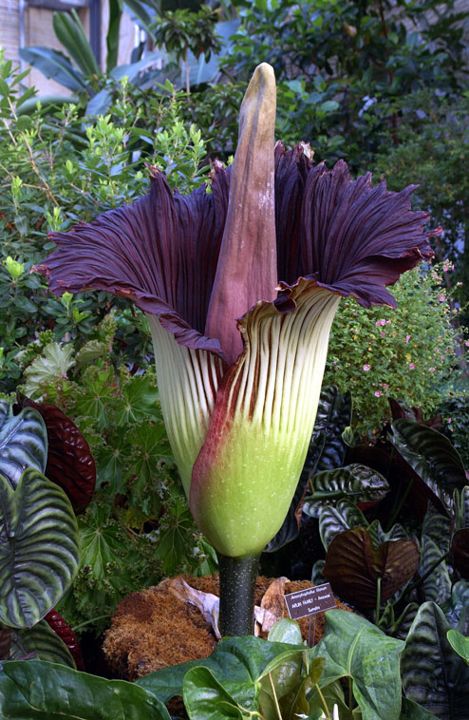
天南星科魔芋属,拥有世界上最大的不分枝花序:佛焰苞像一个巨大的褶边漏斗,外面绿、内面深紫红,中央的肉穗花序直立,高可达 3 米;真正的花小,藏在佛焰苞底部。一片像小树一样分枝的巨大单叶从沉重的块茎(可达上百公斤)长出,为开花积蓄多年的养分。开花极不频繁、只持续一两天,开放时散发强烈的腐肉臭味引来传粉的甲虫和蝇,所以叫「尸花」(印尼语 bunga bangkai)。各地植物园开花都是新闻事件。
Photo: US Botanic Garden, via Wikimedia Commons, public domain / CC0. Unmodified apart from resizing.
Colour
red, purple, green, yellow
Region
Elsewhere (in East Asia only in bird parks or botanic gardens)
Season
year-round
Shape
large head
Identification
An arum with the largest unbranched inflorescence in the world: a spathe like a huge frilled funnel, green outside and deep purple-red within, round an upright spadix that can reach 3 m; the true flowers are small and hidden at the base of the spathe. A single enormous leaf branched like a small tree rises from a heavy tuber (up to a hundred kilograms or more) and stores food for years before a flowering. It flowers rarely and for only a day or two, giving off a powerful stench of rotting flesh that draws pollinating beetles and flies, hence corpse flower (bunga bangkai in Indonesian). A flowering at any botanic garden is a news event.
Habitat
Rainforest at home; grown only in botanic-garden glasshouses in heat, humidity and huge pots.
Distribution
Endemic to Sumatra; entirely a botanic-garden plant in East Asia, having flowered and drawn queues at the Singapore Botanic Gardens and Gardens by the Bay, in China (Beijing Botanical Garden, Xishuangbanna) and in Japan (Koishikawa, Tsukuba, Kyoto).
Season and behaviour
No season: a plant flowers once every several years for one or two days, usually opening in the evening and fullest the next morning.
Photography tips
These are the FilmAnalysis editors' notes, not content from the sources.
With a day or two of flowering, watch the garden's announcements and go the evening it opens and the next morning. Glasshouse light is mixed, so set white balance by hand, and use a wide lens to put the three-metre inflorescence beside a person for scale; the deep purple-red frilled interior wants a macro or long lens. The queue and the pinched noses are a human subject. A time-lapse of the opening.
Photographic styles
A giant inflorescence framed with people; the deep purple-red of the frilled spathe.
Similar species
Konjac, Amorphophallus konjac (far smaller, seen in eastern China); other Amorphophallus; Rafflesia arnoldii (the largest single flower, another family).
Related badge
None yet. No validated photo recognition exists for this species, so no badge is tied to it: a name in the encyclopedia is not evidence in a photograph.
The illustration is original FilmAnalysis artwork. The photograph is from Wikimedia Commons; its licence and author are under it.
Why it is listed: this species comes from the Flower checklist (GBIF backbone and Wikidata verified). Names follow the GBIF backbone and Wikidata; the facts follow the sources below; photo recognition is not offered.