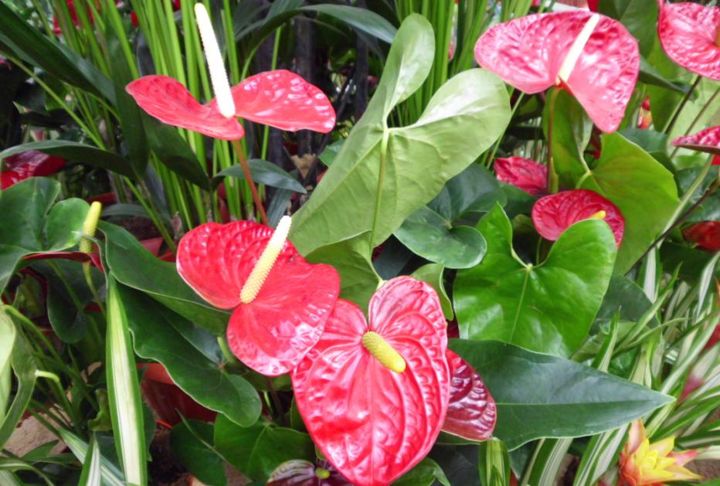
A short erect monocot perennial of warm shady humid rainforest. Entire heart-shaped leaves, usually reflexed, with a cordate base and acuminate tip on cylindrical stalks of 30–40 cm. Its ornamental mark is the spathe: cartilaginous and waxy, red or pink (also white, green and purple), 8–15 cm long, like a lacquered heart; the spadix stands out 7–9 cm, white or yellow like a candle, bearing many small hermaphrodite flowers. Flowers all year. A fleshy berry. Holder of the Royal Horticultural Society's Award of Garden Merit. Among Taiwan's ten export flowers.
Habitat
Rainforest floor and as an epiphyte; mass-produced under glass as a pot and cut flower, outdoors in tropical gardens.
Distribution
Native to Colombia and south-western Ecuador; common in Singapore's parks and interiors, produced in quantity as cut and pot flowers in southern China (Guangdong, Hainan, Taiwan), a pot and cut flower in Japan (ansuriumu) and a house plant in the north.
Season and behaviour
All year; one spathe lasts a month or two, among the longest-lasting of flowers.
Photography tips
These are the FilmAnalysis editors' notes, not content from the sources.
The waxy spathe flares hard, so side light for texture leaves a highlight; a softbox or cloud is steadiest, a stop under for red. The heart seen straight down is most graphic, with the spadix slightly off-axis so it throws a shadow on the spathe. Dark green heart leaves behind. A minimal cut-flower still life is its strength.
Photographic styles
A red heart from above; waxy sheen in side light.
Similar species
Foliage anthuriums such as the crystal anthurium (white-veined leaves, inconspicuous spathe); calla lily (white funnel spathe); red and pink anthuriums are colour forms of the same species.
Related badge
None yet. No validated photo recognition exists for this species, so no badge is tied to it: a name in the encyclopedia is not evidence in a photograph.
The illustration is original FilmAnalysis artwork. The photograph is from Wikimedia Commons; its licence and author are under it.
Why it is listed: this species comes from the Flower checklist (GBIF backbone and Wikidata verified). Names follow the GBIF backbone and Wikidata; the facts follow the sources below; photo recognition is not offered.