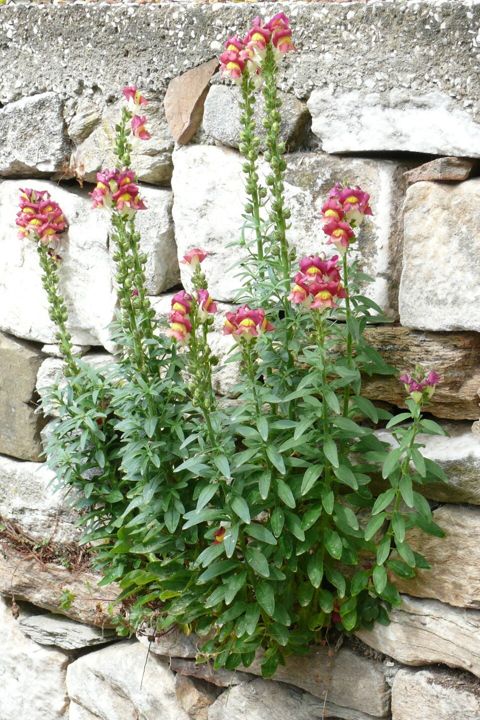
A perennial usually grown as an annual or biennial, 0.5–1 m tall. Spirally arranged broadly lanceolate leaves 1–7 cm. Flowers on a tall spike, each 3.5–4.5 cm, zygomorphic, two lips closing the corolla tube; squeezed at the sides the mouth snaps open like a dragon's or a goldfish's, hence snapdragon and the Chinese goldfish grass. Wild plants pink to purple often with yellow lips, cultivars red, pink, orange, yellow and white; eight to thirty flowers per spike. The genus name means nose-like. A model organism in genetics.
Habitat
Beds, borders and cut-flower fields, liking cool weather; on rocks and walls in its homeland.
Distribution
Native to the Mediterranean from Morocco and Portugal to southern France, Turkey and Syria; common in spring beds and as a cut flower across China and Japan (kingyosō), occasional at cool-house flower shows in Singapore.
Season and behaviour
April to June, March to May in the south; a spike opens from the bottom up and lasts two or three weeks.
Photography tips
These are the FilmAnalysis editors' notes, not content from the sources.
A spike wants a portrait frame, the gradient from open flowers below to buds above being the compositional clue. Squeezing the mouth open for the dragon's jaws is a children's classic, in macro from the side. Rows of coloured spikes in a bed compress with a long lens. Half a stop under for white and yellow forms.
Photographic styles
Coloured spikes in portrait; the open dragon's mouth close up.
None yet. No validated photo recognition exists for this species, so no badge is tied to it: a name in the encyclopedia is not evidence in a photograph.
The illustration is original FilmAnalysis artwork. The photograph is from Wikimedia Commons; its licence and author are under it.
Why it is listed: this species comes from the Flower checklist (GBIF backbone and Wikidata verified). Names follow the GBIF backbone and Wikidata; the facts follow the sources below; photo recognition is not offered.