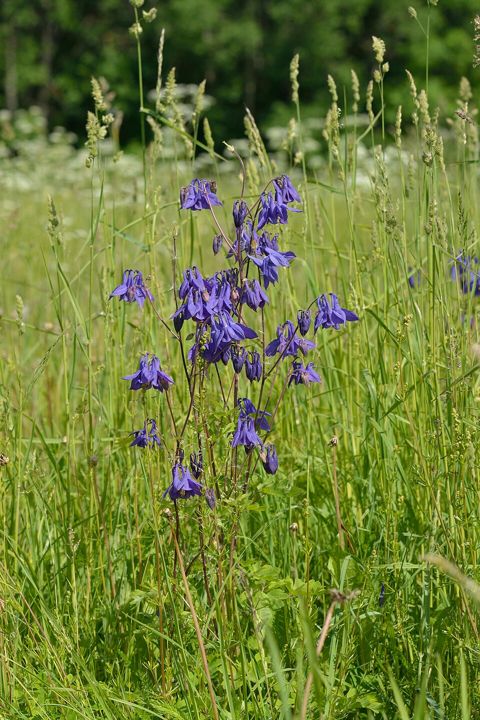
A perennial with a thick rootstock and one or two flowering stems, often in bushy clumps; leafy hairy stems 50–90 cm. Many basal leaves, twice ternate with rounded notched blue-green leaflets. Nodding flowers with five petal-like sepals and five petals, each petal drawn out into a hooked spur curving back, like five doves sitting in a ring (the genus name from eagle or dove), blue-violet in the wild and pink, white, red and double in cultivars. The most widespread and variable species of its genus.
Habitat
Forest edge, grassland, limestone slopes and garden borders in moist half shade; grown as a perennial in East Asia and escaped.
Distribution
Native to Europe and introduced and naturalised in Asia, Oceania, North and South America; grown in borders across China with escapes in the north; grown in Japan (seiyō-odamaki, as against the native odamaki). Absent from Singapore.
Season and behaviour
May and June, late May in the north; two or three weeks.
Photography tips
These are the FilmAnalysis editors' notes, not content from the sources.
Nodding flowers must be shot from below or the side to show the hooked spurs; blue-violet is truest under cloud. Against the light the sepals turn translucent. The blue-green leaves are a soft background. A single flower in macro for the curve of the spurs and yellow stamens.
Photographic styles
Hooked spurs in profile; blue-violet among blue-green leaves.
Similar species
Aquilegia yabeana (purple-red, inward-curved spurs, wild in northern China); Aquilegia buergeriana (Japan's native odamaki, yellow-brown and purple); spurless columbine (no spurs).
Related badge
None yet. No validated photo recognition exists for this species, so no badge is tied to it: a name in the encyclopedia is not evidence in a photograph.
The illustration is original FilmAnalysis artwork. The photograph is from Wikimedia Commons; its licence and author are under it.
Why it is listed: this species comes from the Flower checklist (GBIF backbone and Wikidata verified). Names follow the GBIF backbone and Wikidata; the facts follow the sources below; photo recognition is not offered.