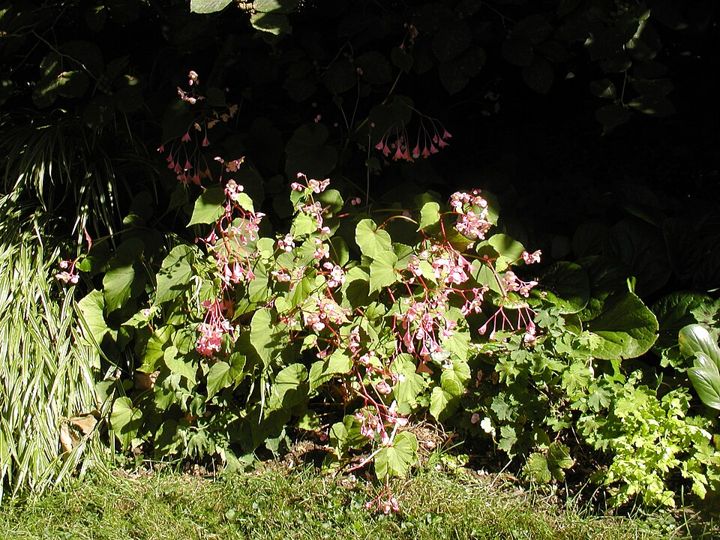
A tuberous perennial that forms bulbils in the leaf axils. Arching stems with alternate simple leaves, obliquely heart-shaped and often purple-red beneath; pink or white flowers in dichotomously branching cymes, male and female on the same plant, the males with two large and two small tepals and the females with a three-winged ovary. Flowers from late summer into autumn. As hardy begonia suggests, it overwinters in temperate regions as tubers and bulbils, even in south-western Japan. Old Chinese names call it the heartbreak flower and the herb of longing.
Habitat
Damp shaded rocks in valleys, streamsides, forest floor and wall crevices, loving cool shade; also grown in the shady corners of gardens.
Distribution
Native to China (most of the north and south), Japan and Malaysia; common in valleys from northern to southern China and naturalised in Japan (shūkaidō, introduced in the Edo period). Absent from Singapore.
Season and behaviour
July to October, peaking in August and September; bulbils form in the leaf axils after flowering and drop in October.
Photography tips
These are the FilmAnalysis editors' notes, not content from the sources.
The purple-red of the leaf underside glows against the light, and with the oblique leaf shape makes a more distinctive picture than the flowers; the flowers hang, so shoot from below. Damp valleys are dim, so a tripod and high ISO. Begonias on a wet rock face after rain, beaded with drops, are best.
Photographic styles
Leaves glowing red against the light; pink flowers in a shaded valley.
Similar species
Wax begonia (cultivated, low, symmetrical glossy leaves); other wild begonias (many in the south-west, different leaf shapes).
Related badge
None yet. No validated photo recognition exists for this species, so no badge is tied to it: a name in the encyclopedia is not evidence in a photograph.
The illustration is original FilmAnalysis artwork. The photograph is from Wikimedia Commons; its licence and author are under it.
Why it is listed: this species comes from the Flower checklist (GBIF backbone and Wikidata verified). Names follow the GBIF backbone and Wikidata; the facts follow the sources below; photo recognition is not offered.