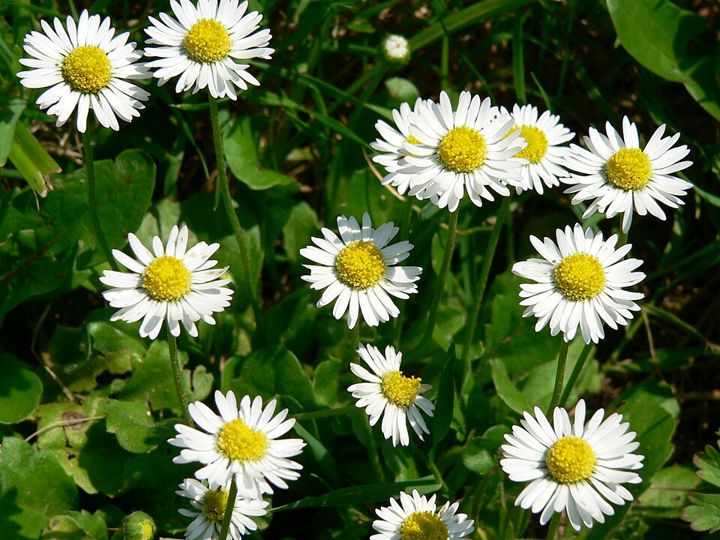
A perennial no more than 20 cm tall with short creeping rhizomes and rosettes of small rounded or spoon-shaped leaves 2–5 cm flat to the ground. Heads 2–3 cm across of white rays (often red-tipped) round a yellow disc, each on a single leafless stem 2–10 cm, following the sun by day and closing at night and in dull weather. The wild plant colonises lawns in Europe and resists mowing, hence lawn daisy; double pink, red and white cultivars are the stars of winter and spring beds. The epithet means perennial, but Japan's hot summers make it an autumn-sown annual there.
Habitat
Lawns, grassland, roadsides and beds, tolerant of trampling and frost; mainly a winter-spring bedding and pot plant in East Asia.
Distribution
Native to Europe and western Asia and widely naturalised in temperate regions; grown in winter-spring beds across China with escapes in the north, common in Japanese beds (hinagiku), scarce in Singapore.
Season and behaviour
March to September in Europe, February to May in East Asian beds; open only by day.
Photography tips
These are the FilmAnalysis editors' notes, not content from the sources.
The flowers hug the ground, so lie down and shoot at their level to see the pink tips under the white rays; from above for the yellow disc and radiating rays. Daisies across a lawn want a wide lens from low, flowers in front and grass behind. Dew on closed morning buds is a macro subject. Half a stop under for white.
Photographic styles
White flowers low across a lawn; closed dewy buds.
Similar species
Mauranthemum paludosum (larger heads, pinnate leaves); chamomiles; English daisy is the horticultural name for this species.
Related badge
None yet. No validated photo recognition exists for this species, so no badge is tied to it: a name in the encyclopedia is not evidence in a photograph.
The illustration is original FilmAnalysis artwork. The photograph is from Wikimedia Commons; its licence and author are under it.
Why it is listed: this species comes from the Flower checklist (GBIF backbone and Wikidata verified). Names follow the GBIF backbone and Wikidata; the facts follow the sources below; photo recognition is not offered.