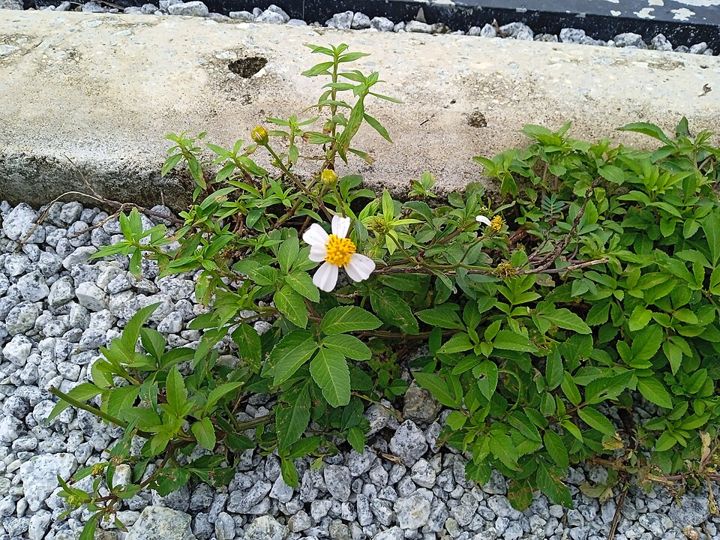
Photo: Wiki Farazi, via Wikimedia Commons, public domain / CC0. Unmodified apart from resizing.
Colour
white, yellow
Region
Singapore and tropical Asia, Japan and temperate East Asia
Season
summer, autumn
Shape
single flower
Identification
A branched annual of slender habit up to 1.8 m tall. Opposite leaves from simple to pinnate, the upper ones with three to five toothed ovate-lanceolate leaflets on slightly winged petioles. Small heads on longish stalks, four or five broad white ray florets round many yellow disc florets; the fruits are black, slightly curved stiff rods about 1 cm long with two or three heavily barbed awns at the tip that hitch rides on clothes and animals, hence the Chinese name ghost needle.
Habitat
Disturbed ground: roadsides, waste land, field edges, river beds and building sites, growing aggressively as a weed; classed as invasive for altering soil microbial communities. The whole plant is used in herbal medicine.
Distribution
Native to the Americas and introduced across Eurasia, Africa, Australia and the Pacific islands. Very common in southern China and Taiwan and on waste ground in southern Japan and Singapore.
Season and behaviour
Can flower at any time of year, mainly summer and autumn in temperate regions; the black needle-ball seed heads are most plentiful in autumn and winter.
Photography tips
These are the FilmAnalysis editors' notes, not content from the sources.
Only four or five ragged white rays, and a head-on macro shows their lopsided beauty; the barbed seed ball against the light becomes a radiating star, with a wide aperture so every awn gets a highlight. Butterflies and bees come constantly, so one clump is enough.
Photographic styles
Macro of an unregarded wildflower; backlit seed-ball silhouettes.
Similar species
Bidens alba (larger neater rays, sometimes lumped with it); Bidens bipinnata (no ray florets).
Related badge
None yet. No validated photo recognition exists for this species, so no badge is tied to it: a name in the encyclopedia is not evidence in a photograph.
The illustration is original FilmAnalysis artwork. The photograph is from Wikimedia Commons; its licence and author are under it.
Why it is listed: this species comes from the Flower checklist (GBIF backbone and Wikidata verified). Names follow the GBIF backbone and Wikidata; the facts follow the sources below; photo recognition is not offered.