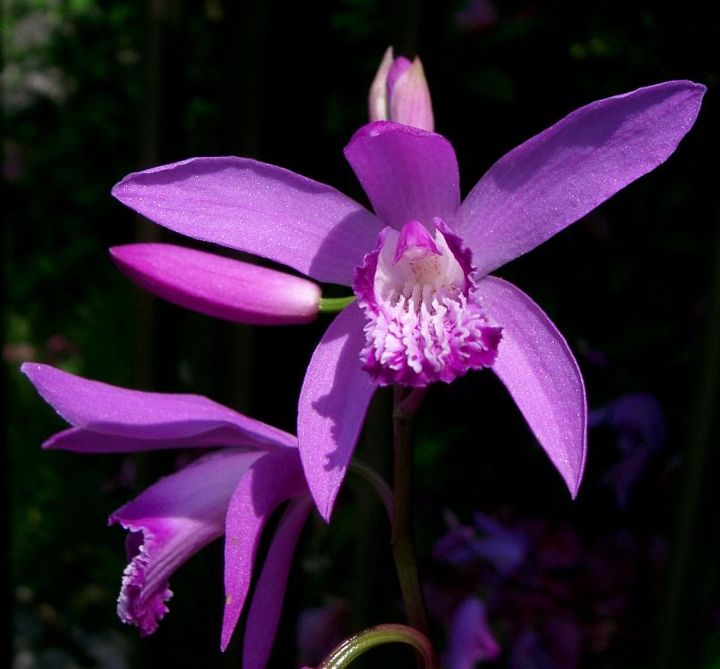
A terrestrial orchid with pleated, spear-shaped leaves ribbed lengthwise, which the epithet striped refers to. It breaks dormancy in early spring, each pseudobulb sending up several shoots, which in a couple of months bear three to seven magenta-pink flowers with a frilled, dark-striped lip; white forms are common. The pseudobulb is the traditional styptic bai ji.
Habitat
Grassy slopes, forest edge and streamsides on sandy soil, in clumps; widely planted in gardens and beds, one of the easiest orchids to grow.
Distribution
Native to Japan, Korea, Myanmar and China (Anhui, Fujian, Gansu, Guangdong, Guangxi, Guizhou, Hubei, Hunan, Jiangsu, Jiangxi, Shaanxi, Sichuan, Zhejiang); common on hillsides south of the Yangtze, the wild plants reduced by collecting; commonly grown throughout Japan (shiran). Absent from Singapore.
Season and behaviour
April and May, about three weeks in flower; the leaves keep growing after flowering and yellow in autumn.
Photography tips
These are the FilmAnalysis editors' notes, not content from the sources.
Magenta is truest under cloud or in the diffuse light of half shade and turns purple and glaring in sun; a side macro for the frills and stripes of the lip. The pleated leaves show their ribs against the light, a subject beyond the flower. In a clump of several stems use a wide aperture to pick one.
Photographic styles
Magenta orchids in half shade; backlit texture of pleated leaves.
Similar species
Bletilla formosana (small yellowish-white flowers); spring and faber orchids (strap leaves without pleats, green-yellow flowers); other cultivated ground orchids.
Related badge
None yet. No validated photo recognition exists for this species, so no badge is tied to it: a name in the encyclopedia is not evidence in a photograph.
The illustration is original FilmAnalysis artwork. The photograph is from Wikimedia Commons; its licence and author are under it.
Why it is listed: this species comes from the Flower checklist (GBIF backbone and Wikidata verified). Names follow the GBIF backbone and Wikidata; the facts follow the sources below; photo recognition is not offered.