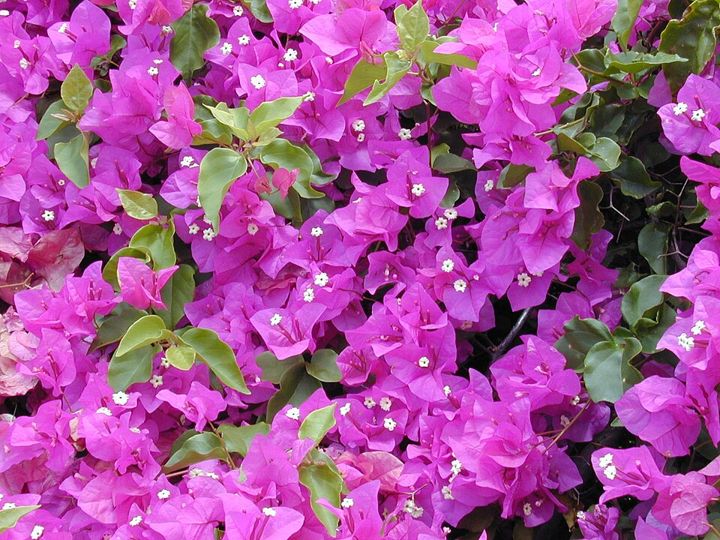
An evergreen woody vine or shrub 4.6–12 m with heart-shaped leaves and thorny downy stems. The true flowers are small, white and inconspicuous, in threes, each tucked into a bright bract (a modified leaf), the three bracts forming a cluster, hence the Chinese name three-corner plum; bracts white, red, mauve, purple-red or orange, papery and long-lasting. The fruit an inconspicuous dry achene. The genus honours the French navigator Bougainville and the epithet means striking.
Habitat
Walls, pergolas, overpasses and roadsides in the tropics and subtropics, very drought-tolerant and sun-loving; one of the main ornamental climbers of southern China and South-East Asia.
Distribution
Native to Brazil, Bolivia, Peru and Argentina's Chubut province, introduced throughout the tropics and subtropics; very common on Singapore's overpasses and roadsides, the city flower of several southern Chinese cities (Shenzhen, Xiamen, Jiangmen) and grown across Guangdong, Fujian, Hainan, Yunnan and Taiwan, glasshouse-only in Japan outside Okinawa.
Season and behaviour
All year in the tropics, most in the dry season; November to April in southern China, when dry weather brings the most bracts.
Photography tips
These are the FilmAnalysis editors' notes, not content from the sources.
The bracts are papery and translucent, so backlight is the light: a whole cluster lit through like coloured paper. Purple-red bleeds in sun, half a stop under. Cascades of bougainvillea hanging from Singapore's overpasses are the local emblem, compressed with a long lens. Macro on the small white flower at the centre of three bracts, which is the real flower.
Photographic styles
Papery bracts against the light; a cascading flower wall on an overpass.
Similar species
Bougainvillea glabra (hairless leaves, smaller bracts, commoner, the two often confused and hybridised); Bougainvillea peruviana; most cultivars are hybrids.
Related badge
The album badge "bougainvillea" unlocks when the vision model explicitly names a bougainvillea in your photo and you rate the analysis. The badge stops at "bougainvillea": it does not tell species apart, and this page existing unlocks nothing.
The illustration is original FilmAnalysis artwork. The photograph is from Wikimedia Commons; its licence and author are under it.
Why it is listed: this species comes from the Flower checklist (GBIF backbone and Wikidata verified). Names follow the GBIF backbone and Wikidata; the facts follow the sources below; photo recognition is not offered.