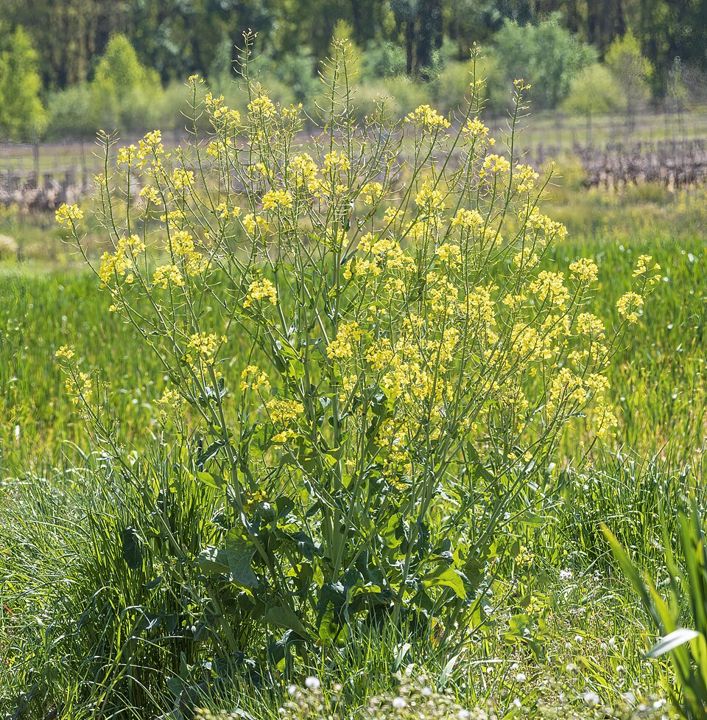
A herb to 100 cm with stalked, hairless, fleshy, pinnatifid, glaucous lower leaves and stalkless clasping upper ones. Bright yellow flowers about 17 mm across, four petals in a cross alternating with four sepals, in indeterminate racemes opening from the lowest bud upward; two short lateral stamens and four long median ones. Slender pods green then brown, 5–10 cm. Winter and spring types; the seed is pressed for oil containing erucic acid, the low-erucic cultivars being canola, the world's third largest source of vegetable oil.
Habitat
Farmland on a huge scale; the spring rapeseed fields are among the most spectacular flower landscapes of southern China and rural Japan (Wuyuan, Luoping, Hanzhong; Chiba, Yokohama in Aomori).
Distribution
Originated in Europe as a hybrid of cabbage and turnip; grown on a large scale in the Yangtze basin and south-west and north-west China, grown and naturalised throughout Japan (seiyō-aburana, most of the spring nanohana on river banks), absent from Singapore.
Season and behaviour
February to March in the south (Luoping in February, Wuyuan in March), March to April in the Yangtze basin, April to July in Hanzhong and Qinghai; March and April in Japan. A field flowers for about three weeks.
Photography tips
These are the FilmAnalysis editors' notes, not content from the sources.
A rapeseed sea is a landscape subject: the geometry of fields from above, or a wide lens from low with the sky; yellow clips at noon, so a stop under and early or late light. Terraces in morning mist (Wuyuan, Luoping) have the most depth. Macro for the four-petalled cross and six stamens. Bees are everywhere, 1/1600 s.
Photographic styles
The geometry of yellow fields; terraces in morning mist.
Similar species
Turnip rape, Brassica rapa (leaves clasping more clearly, smaller flowers, the traditional Chinese rape); mustard rape (stalked leaves that do not clasp).
Related badge
The album badge "rapeseed flowers" unlocks when the vision model explicitly names a rapeseed flowers in your photo and you rate the analysis. The badge stops at "rapeseed flowers": it does not tell species apart, and this page existing unlocks nothing.
The illustration is original FilmAnalysis artwork. The photograph is from Wikimedia Commons; its licence and author are under it.
Why it is listed: this species comes from the Flower checklist (GBIF backbone and Wikidata verified). Names follow the GBIF backbone and Wikidata; the facts follow the sources below; photo recognition is not offered.