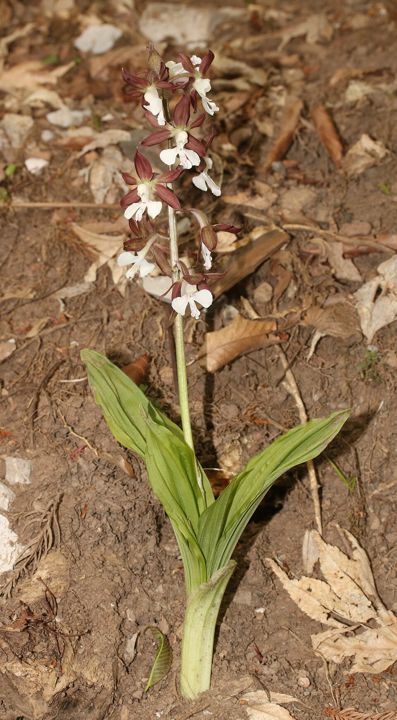
A terrestrial orchid whose pseudobulbs, about 2 cm, link up near the surface like a shrimp (the Japanese name ebine means shrimp root) and persist for over a decade. Two or three thin leaves with five lengthwise veins on slender stalks; new shoots emerge in autumn, grow a little and overwinter green. In spring a 30–40 cm stem carries many flowers on its upper half, held horizontally, with brown-purple sepals and petals and a white or pink three-lobed lip with a spur.
Habitat
Moist humus under evergreen broadleaf forest at 780–1,500 m in half shade; common in Japan's low hill woodland, where a huge range of garden forms has been bred.
Distribution
Native to Japan (the type locality, including the Ryukyus), Korea and China (Zhejiang, Jiangsu, northern Fujian, Hubei, northern Guangdong, southern Guizhou, Anhui, Hunan, Jiangxi); scattered in the hills of eastern China, common throughout Japan but the wild plants threatened by collecting. Absent from Singapore.
Season and behaviour
April and May for two or three weeks, under the trees as the new leaves open; the colour varies greatly by locality.
Photography tips
These are the FilmAnalysis editors' notes, not content from the sources.
Forest-floor light is weak, so a tripod or high ISO; the contrast of brown-purple sepals and white-pink lip reads only in soft light, with a side macro for the three lobes and spur of the lip. The stem is thin, so wait out the breeze. Dark leaf litter behind, and no flash. Wild ebine are protected: never dig them up, and never publish a precise location.
Photographic styles
Brown-purple and white orchids on the forest floor; the line of a slender stem.
Similar species
Calanthe sieboldii (yellow, ki-ebine in Japan, hybridises with it); other Calanthe species (different colours and lip shapes).
Related badge
None yet. No validated photo recognition exists for this species, so no badge is tied to it: a name in the encyclopedia is not evidence in a photograph.
The illustration is original FilmAnalysis artwork. The photograph is from Wikimedia Commons; its licence and author are under it.
Why it is listed: this species comes from the Flower checklist (GBIF backbone and Wikidata verified). Names follow the GBIF backbone and Wikidata; the facts follow the sources below; photo recognition is not offered.