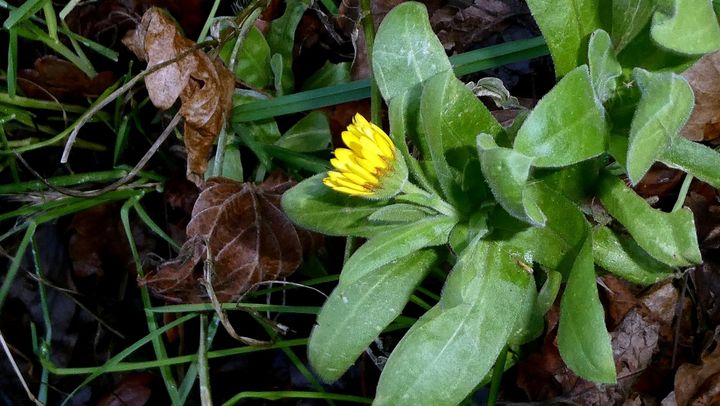
Photo: Patrick Le Mao, via iNaturalist, public domain / CC0. Unmodified apart from resizing.
Colour
orange, yellow
Region
Japan and temperate East Asia
Season
spring, winter
Shape
single flower
Identification
A short-lived aromatic perennial (usually grown as an annual) to 80 cm with lax or upright sparsely branched stems. Oblong-lanceolate leaves 5–17 cm, hairy on both sides, entire or slightly wavy. Yellow or orange heads 4–7 cm across surrounded by two rows of hairy bracts; the wild plant has a single ring of rays round the disc, the hermaphrodite disc florets a deeper orange-yellow; cultivars double. Flowers all year where conditions allow. A thorny curved achene. Edible petals, historically a medicine and dye; the English name honours the Virgin Mary.
Habitat
Beds, borders, vegetable gardens and roadsides, hardy and the mainstay of winter and spring beds; escaped onto waste ground.
Distribution
Probably native to southern Europe, its origin obscured by long cultivation, and widely naturalised; grown across China and common in southern winter-spring beds; common in Japanese winter-spring beds (kinsenka, the Bōsō flower fields); scarce in Singapore.
Season and behaviour
December to May in the south, April to June in the north; December to May in Japan; the most valuable orange of winter.
Photography tips
These are the FilmAnalysis editors' notes, not content from the sources.
Orange saturates in the low light of winter, straight down for the radiating rays and deeper disc; a stop under in strong sun. Side light for the layered petals of double forms. A bed compresses with a long lens into an orange block. The curved thorny achenes are a macro subject after flowering.
Photographic styles
Orange in a winter bed; radiating rays seen from above.
Similar species
Marigolds, Tagetes (pinnate scented leaves, another genus); coreopsis (perennial, different leaves); field marigold, Calendula arvensis (small flowers, wild).
Related badge
None yet. No validated photo recognition exists for this species, so no badge is tied to it: a name in the encyclopedia is not evidence in a photograph.
The illustration is original FilmAnalysis artwork. The photograph is from iNaturalist; its licence and author are under it.
Why it is listed: this species comes from the Flower checklist (GBIF backbone and Wikidata verified). Names follow the GBIF backbone and Wikidata; the facts follow the sources below; photo recognition is not offered.