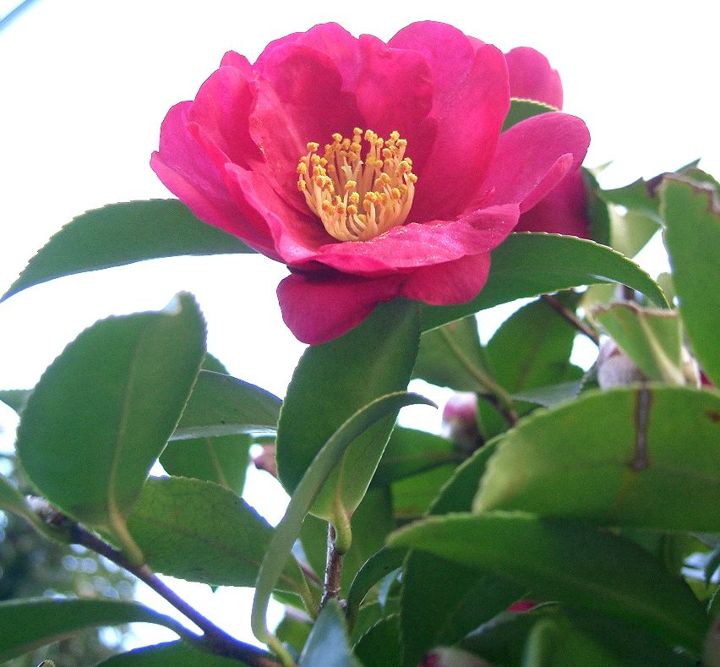
An evergreen shrub or small tree usually 6 m tall, wild plants to 10 m. Alternate leathery leaves, elliptic to ovate, 2.6–6.3 cm, finely serrate, dark glossy green; young twigs, petioles and midribs shortly pubescent. Solitary terminal or axillary flowers 5–7.6 cm across; wild-type flowers with six or seven white petals, cultivars pink, red or bicoloured with over twenty petals. Told from Camellia japonica by petals that fall one by one rather than as a whole flower, smaller leaves and flowers, and autumn-winter flowering. Globose to pear-shaped densely tomentose capsules. The seeds give oil and the leaves tea.
Habitat
Montane evergreen forest and forest edge, widely planted in gardens, temples and hedges, especially commonly in Japan.
Distribution
Native to southern Japan (Shikoku, Kyushu) and the Ryukyus; cultivated in China (eastern and southern gardens) and extremely common in cultivation throughout Japan (sazanka, the flower of the winter nursery song). Absent from Singapore.
Season and behaviour
Early groups from September and October, late ones into April, mainly October to December; a long season, the petals carpeting the ground one by one.
Photography tips
These are the FilmAnalysis editors' notes, not content from the sources.
The low light of autumn and winter suits it, half a stop under for white and a stop for red; petals scattered one by one on moss or stone steps are the picture that separates it from japonica, seen from above. Leaves and flowers are glossy, so side light or a polariser. Under snow, add a stop.
Photographic styles
Petals scattered on moss; flowers in low winter light.
Similar species
Camellia japonica (larger leaves and flowers, whole flowers dropping, January to April); oil-seed camellia (white, similar season, thicker leaves, an oil crop); tea plant (small white autumn flowers).
Related badge
None yet. No validated photo recognition exists for this species, so no badge is tied to it: a name in the encyclopedia is not evidence in a photograph.
The illustration is original FilmAnalysis artwork. The photograph is from Wikimedia Commons; its licence and author are under it.
Why it is listed: this species comes from the Flower checklist (GBIF backbone and Wikidata verified). Names follow the GBIF backbone and Wikidata; the facts follow the sources below; photo recognition is not offered.