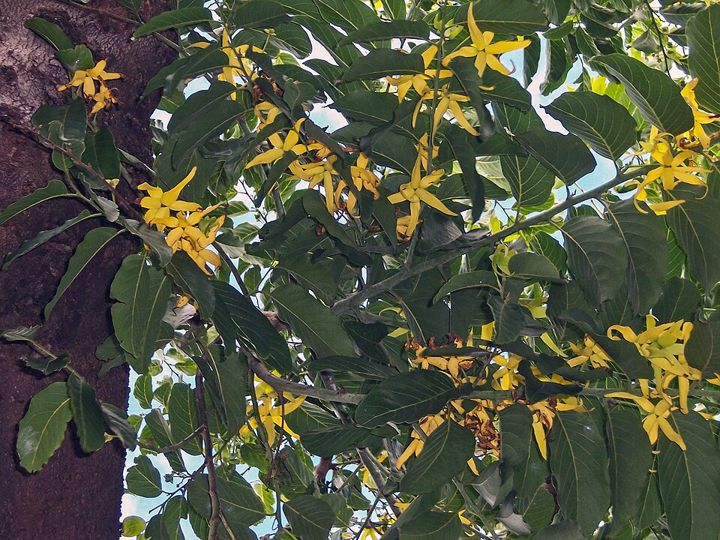
A fast-growing evergreen tree to 30 m, usually with a straight cylindrical trunk and drooping branches. Pinnate leaves with ovate pointed wavy-edged leaflets up to 22 by 9 cm and eight to eleven pairs of veins. Flowers in the leaf axils or on the branches in cymes or panicles on stalks up to 5 cm; intensely fragrant, with six narrow drooping twisted yellow petals up to 9 cm long, pale green at first and yellow when mature, and a small green calyx. The flowers are distilled into ylang-ylang oil, one of the most used natural fragrances in perfumery, hence the perfume tree.
Habitat
Tropical lowland rainforest and plantations in heat and humidity; widely planted in the tropics as a street and perfume tree.
Distribution
Native from Indochina to north-eastern Australia (Vietnam, Thailand, the Malay Peninsula, Borneo, Java, Sumatra, the Philippines, New Guinea, Queensland and elsewhere) and introduced throughout the tropics; common in Singapore's parks and streets, grown in southern China (Guangdong, Yunnan, Fujian, Guangxi, Taiwan), absent from Japan.
Season and behaviour
All year in the tropics, most from April to August and after rain; scent strongest at night and early morning.
Photography tips
These are the FilmAnalysis editors' notes, not content from the sources.
The pale green to yellow twisted petals hide among the leaves and do not stand out, so get close with a long lens or macro and let backlight shine through the ribbon-like petals. The flowers sit high, so from low against the sky. It is a tree of scent: better than the flower alone is someone smelling it under the tree, or the fallen yellow flowers on the ground.
Photographic styles
Twisted yellow ribbons among the leaves; fallen flowers under the tree.
Similar species
Dwarf ylang-ylang, Cananga odorata var. fruticosa (a shrub, same flower); climbing ylang-ylang, Artabotrys (short thick petals, a vine); Annona (large fruit, small thick flowers).
Related badge
None yet. No validated photo recognition exists for this species, so no badge is tied to it: a name in the encyclopedia is not evidence in a photograph.
The illustration is original FilmAnalysis artwork. The photograph is from Wikimedia Commons; its licence and author are under it.
Why it is listed: this species comes from the Flower checklist (GBIF backbone and Wikidata verified). Names follow the GBIF backbone and Wikidata; the facts follow the sources below; photo recognition is not offered.