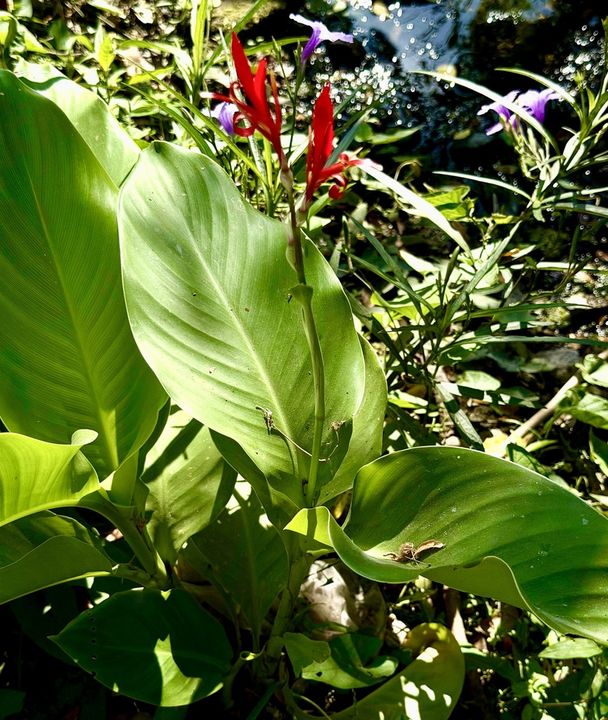
Photo: Drew Baxter, via iNaturalist, public domain / CC0. Unmodified apart from resizing.
Colour
red, orange, yellow
Region
Singapore and tropical Asia, Japan and temperate East Asia
Season
summer, autumn
Shape
single flower
Identification
A perennial 0.5–2.5 m tall depending on the variety. An upright unbranched stem, or a false trunk of overlapping leaf sheaths; branched rhizomes 60 cm long divided into bulbous segments, rich in starch and edible. Very large simple leaves, alternate, spiral or two-ranked, with sheath, short petiole and long-elliptic blade. Flowers red or yellow (orange, pink and spotted in cultivars), the petal-like parts actually modified stamens. A softly spiny capsule with black, extremely hard, round seeds, hence the name Indian shot.
Habitat
Damp roadsides, ditches, pond margins and gardens, tolerant of waterlogging; a minor food crop of the American peoples for thousands of years, naturalised in sub-Saharan Africa, South-East Asia and Oceania. In China the rhizomes replace achira for making starch noodles.
Distribution
Native to the West Indies, Mexico and the south-eastern United States and naturalised through the tropics and subtropics. Naturalised to 800 m in southern and south-western China and planted in parks everywhere; grown from Honshu south in Japan and common by water and in beds in Singapore.
Season and behaviour
June to October, all year in the tropics; a spike opens in succession over several weeks.
Photography tips
These are the FilmAnalysis editors' notes, not content from the sources.
Red and orange bleed easily in sun, so a stop under or overcast light; the huge leaves show their veins against the light and are a subject on their own. The flower's structure is complex, so a side macro for the curl of the petal-like stamens. Cannas by water with their reflection from low down. The hard black seeds and spiny capsules are the autumn close-up.
Photographic styles
Saturated tropical red and giant leaves; backlit leaf veins.
Similar species
Canna × generalis (the garden hybrid, larger flowers); Canna edulis (small red flowers, grown for starch); gingers (different flower shape).
Related badge
None yet. No validated photo recognition exists for this species, so no badge is tied to it: a name in the encyclopedia is not evidence in a photograph.
The illustration is original FilmAnalysis artwork. The photograph is from iNaturalist; its licence and author are under it.
Why it is listed: this species comes from the Flower checklist (GBIF backbone and Wikidata verified). Names follow the GBIF backbone and Wikidata; the facts follow the sources below; photo recognition is not offered.