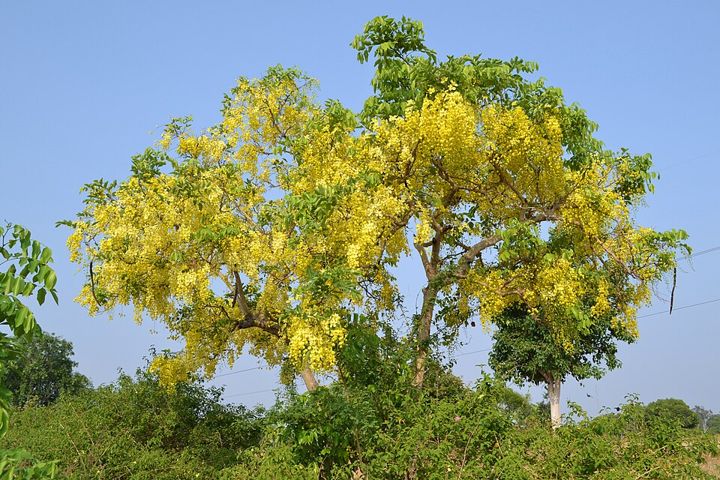
A medium-sized fast-growing tree 10–20 m tall. Deciduous pinnate leaves 15–60 cm long with three to eight pairs of leaflets 7–21 cm long. Flowers in pendulous racemes 20–40 cm long, each 4–7 cm across with five equal yellow petals, the whole tree a golden waterfall, hence the name golden shower; a cylindrical pod 30–60 cm long like a sausage, with a pungent smell and many seeds, which gives the Chinese name sausage tree. Strong durable wood. The national tree and flower of Thailand and the state flower of Kerala. Often miscalled laburnum, which is a poisonous European tree.
Habitat
Tropical streets, parks and campuses, widely planted as an ornamental; native to dry deciduous forest.
Distribution
Native to the Indian subcontinent and adjacent South-East Asia, from southern Pakistan to India, Myanmar and Sri Lanka; widely planted in Singapore, southern China (Guangdong, Hainan, Yunnan) and Taiwan, and grown in Okinawa.
Season and behaviour
Peaks in Singapore's dry season from March to May, in southern China and Taiwan from May to July; in Thailand it flowers around the April New Year, which made it the national flower. About a month, before or with the leaves.
Photography tips
These are the FilmAnalysis editors' notes, not content from the sources.
The hanging golden racemes glow against the light, their finest illumination; dark tree shade behind and half a stop under. The whole tree from low with a wide lens, the racemes hanging before the sky; a single raceme with a long lens. The sausage-like pods hanging on the tree are the other season's subject.
Photographic styles
A golden waterfall against the light; the lines of long pods.
Similar species
Laburnum (Europe, poisonous, small flowers, trifoliate leaves); scrambled-egg tree, Senna surattensis (upright clusters, a shrub); pink shower (pink).
Related badge
None yet. No validated photo recognition exists for this species, so no badge is tied to it: a name in the encyclopedia is not evidence in a photograph.
The illustration is original FilmAnalysis artwork. The photograph is from Wikimedia Commons; its licence and author are under it.
Why it is listed: this species comes from the Flower checklist (GBIF backbone and Wikidata verified). Names follow the GBIF backbone and Wikidata; the facts follow the sources below; photo recognition is not offered.