Singapore and tropical Asia, Japan and temperate East Asia
Season
year-round
Shape
single flower
Identification
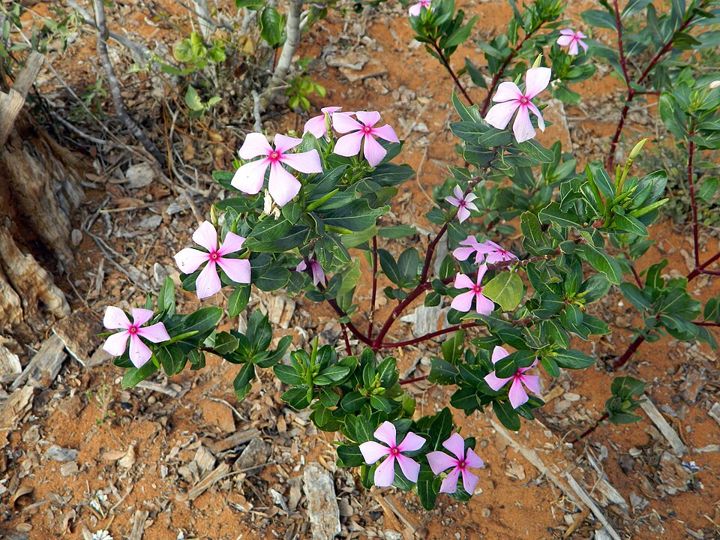
An evergreen subshrub or herb growing to about 1 m. Opposite oval to oblong leaves 2.5–9 cm long, glossy green, hairless, with a pale midrib and short petiole. Flowers from white with a yellow or red centre to dark pink with a darker red centre, a basal tube 2.5–3 cm long and a corolla 2–5 cm across with five petal-like lobes like a pinwheel. The fruit a pair of follicles 2–4 cm long. Named day-by-day spring in Chinese because it flowers every day. The source of the anticancer drugs vincristine and vinblastine.
Habitat
Roadsides, waste ground, gardens and beds, heat- and drought-tolerant and freely self-seeding; weedy on the dry coasts of its native Madagascar.
Distribution
Native and endemic to Madagascar, now pantropical as an ornamental and medicinal plant; very common in Singapore and southern China, and grown as an annual bedding plant in Japan (nichinichisō).
Season and behaviour
Flowers all year in the tropics, April to November in southern China, summer in Japan; new flowers every day, staying open even in hard afternoon sun.
Photography tips
These are the FilmAnalysis editors' notes, not content from the sources.
The contrasting eye (white petals with a red centre, pink with a dark red one) is the macro point, straight down onto the five pinwheel lobes; pink saturates only in soft light. It is open at noon but the light is too hard, so use a diffuser. Roadside beds compress into blocks of colour with a long lens.
Photographic styles
Head-on macro of pinwheel flowers; blocks of colour in beds.
None yet. No validated photo recognition exists for this species, so no badge is tied to it: a name in the encyclopedia is not evidence in a photograph.
The illustration is original FilmAnalysis artwork. The photograph is from Wikimedia Commons; its licence and author are under it.
Why it is listed: this species comes from the Flower checklist (GBIF backbone and Wikidata verified). Names follow the GBIF backbone and Wikidata; the facts follow the sources below; photo recognition is not offered.