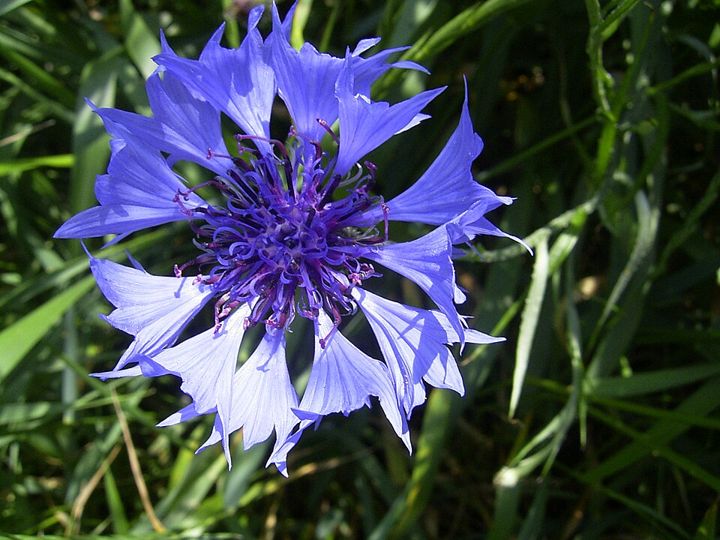
An annual 20–100 cm tall with grey-green branched stems. Lanceolate leaves 3–10 cm. Flowers most often an intense blue (cultivars pink, white, purple and deep red) in heads 1.5–3 cm across, a ring of a few large spreading ray-like florets round a central cluster of small disc florets; the blue pigment is protocyanin, which in roses is red. Achenes about 3.5 mm with a 2–3 mm pappus. Flowers all summer. The national flower of Germany, endangered in its native fields by herbicides.
Habitat
Once a weed of cornfields (hence the name), now a bed, border, flower-field and cut-flower plant and a component of wildflower mixes; in sun on poor soil.
Distribution
Native to temperate Europe and naturalised in North America, Australia and elsewhere; grown and escaped across China, naturalised in Xinjiang; introduced to Japan in the Meiji era and common in beds (yagurumagiku, named for the pinwheel of carp streamers). Absent from Singapore.
Season and behaviour
May to July, April to June in Japan; a field flowers for over a month, often mixed with corn poppies.
Photography tips
These are the FilmAnalysis editors' notes, not content from the sources.
Cornflower blue is a rare pure blue among flowers, truest under cloud and at dawn and purplish in sun; a head-on macro for the ring of little trumpet-like outer florets and the deep purple disc. Blue dots in a cornfield or flower field compress with a long lens, or pair with red poppies as complementary colours. The grey-green stems and leaves have a silver sheen against the light.
Photographic styles
Pure blue radiating florets; blue dots in a flower field.
Similar species
Perennial cornflower (larger pale violet-blue heads); scabious (pale blue heads without the trumpet florets); thistles (spiny).
Related badge
None yet. No validated photo recognition exists for this species, so no badge is tied to it: a name in the encyclopedia is not evidence in a photograph.
The illustration is original FilmAnalysis artwork. The photograph is from Wikimedia Commons; its licence and author are under it.
Why it is listed: this species comes from the Flower checklist (GBIF backbone and Wikidata verified). Names follow the GBIF backbone and Wikidata; the facts follow the sources below; photo recognition is not offered.