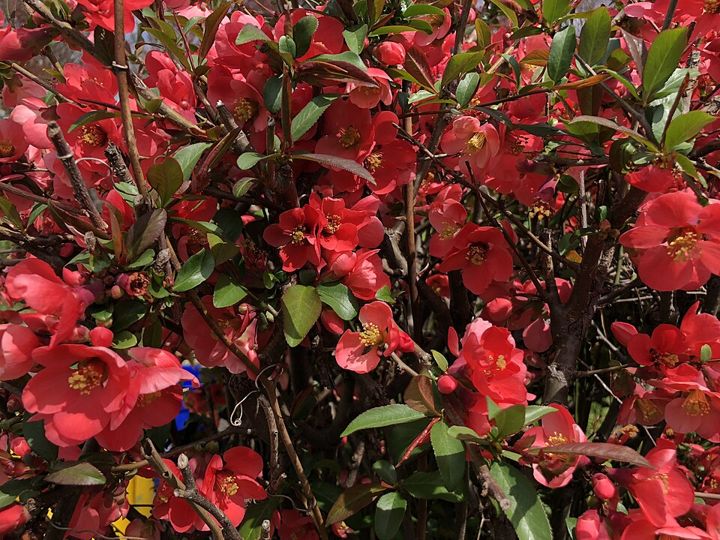
A thorny deciduous or semi-evergreen shrub about 2 m tall, taller than the Japanese quince. Flowers usually red, also pink, white or greenish cultivars, three to five clustered on old wood, almost stalkless and pressed to the branch, hence the Chinese name stem-hugging crabapple; before or with the leaves, five-petalled with many stamens. The fruit is a fragrant hard pome like a quince, the mugua of ancient texts (the Book of Songs: you gave me a quince, I returned a jade pendant); Xuancheng's fruit is medicinal. The epithet means showy.
Habitat
Hillside scrub and roadsides, widely planted in gardens, parks and hedges and as bonsai; hardy and drought-tolerant.
Distribution
Native to eastern and central China (Shaanxi, Gansu, Sichuan, Guizhou, Yunnan, Guangdong and elsewhere), grown everywhere, with Xuancheng in Anhui the medicinal source; commonly grown in Japan (boke, the early-spring bonsai flower). Absent from Singapore.
Season and behaviour
March and April, April in the north, before the leaves, for two or three weeks; a few flowers in January after a mild winter; fruit in September and October.
Photography tips
These are the FilmAnalysis editors' notes, not content from the sources.
Flowers pressed to the branch want the line of the branch and the arrangement of the flowers, best in side light against a dark background; a stop under for red. Before the leaves the bare wood and red flowers contrast strongly, so do not wait for foliage. A quince bonsai with moss and a ceramic pot is the traditional Japanese still life. The hard yellow-green fragrant fruit in autumn is worth a frame too.
Photographic styles
Red flowers hugging bare branches; an early-spring bonsai still life.
Similar species
Japanese quince, Chaenomeles japonica (low, orange-red, sprawling); Chinese quince, Pseudocydonia sinensis (a tree, pink flowers, large fruit); Hall crabapple (long drooping pedicels).
Related badge
None yet. No validated photo recognition exists for this species, so no badge is tied to it: a name in the encyclopedia is not evidence in a photograph.
The illustration is original FilmAnalysis artwork. The photograph is from Wikimedia Commons; its licence and author are under it.
Why it is listed: this species comes from the Flower checklist (GBIF backbone and Wikidata verified). Names follow the GBIF backbone and Wikidata; the facts follow the sources below; photo recognition is not offered.